Featured

Developing Agency

“‘You have also taught me to be wild,’ said the robot. ‘So let us all celebrate life and wildness, together!'”

The Wild Robot, Peter Brown

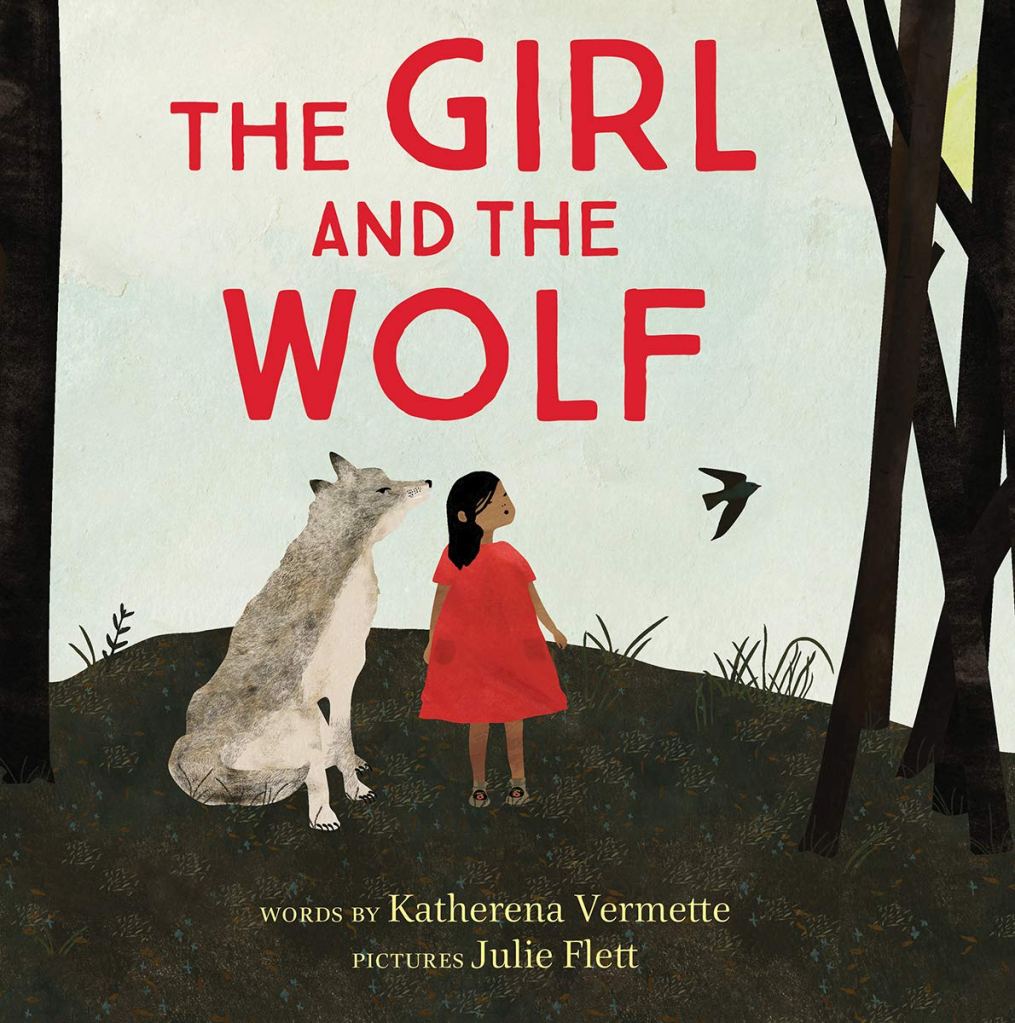
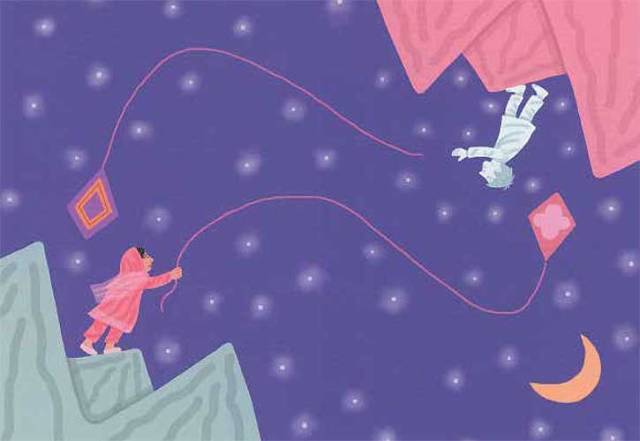
The Girl and the Wolf, a short story written by Katherena Vermette and illustrated by Julie Flett, seems to take a twist on the classically known story of Little Red Riding Hood. The story features an Indigenous girl who gets lost in the woods while out with her mother. In the woods, she meets a wolf; but instead of the wolf following her to granny’s house and eating the girl, the wolf helps guide the girl back to her mother. He reminds her of her own abilities to survive and find her way back home to her mother.
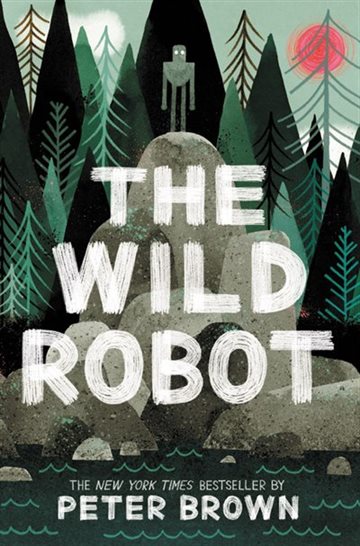
Similar in theme, The Wild Robot, a novel written and illustrated by Peter Brown, is about a robot named ROZZUM unit 7134 (but you may call her Roz), who ends up on an island after a hurricane crashes her ship. The robot must adapt to her unfamiliar surroundings and learn from the animals inhabiting the island in order to survive. At first, this is difficult for Roz, who appears to be a shiny and scary monster to the animals on the island, who greet her with hostility and fear. Over time, though, Roz begins to pick up a thing or two that will help her survive, and she begins to make friends with the locals.

What I enjoyed about both of these books is that they are both relatable to a large audience of readers. Though Vermette and Brown’s books are fictitious and a bit fantastical (as we all know wolves don’t talk and robots don’t just randomly end up stranded on islands in real life), the feelings they depict in their books—of feeling lost, survival, building trust—are all universal experiences we can all relate to on an emotional level.

Brown does an exceptional job of this in his novel, which delves deeper into the experiences many minority communities often face: fear of exclusion, being viewed by others as a “monster” for being different, learning a new language, and the uncertainty of how to make friends in a new culture.

“Roz wandered the island, covered in dirt and green growing things, and everywhere she went, she heard unfriendly words. The words would have made most creatures quite sad, but as you know, robots don’t feel emotions, and in these moments that was probably for the best.”

The Wild Robot, p. 53

All the animals were scared of Roz in the beginning, calling her a monster, simply because she was new and different and at first didn’t know the language of the animals. This is not unlike the treatment of immigrants from the Latinx community (or people who simply look like immigrants) in the United States right now. Fear of the unknown is a common theme worldwide and though not explicitly stated, Brown does an excellent job of alluding to this fear throughout his novel.

Another theme that arose in The Wild Robot was that of motherhood—or even parenthood in general. Roz saves and adopts a gosling she names Brightbill, whose family was killed in an accident on the island, and struggles with the new responsibility of parenting—an unusual thing for a robot to do. She seeks help from one of the older geese on the island, Loudwing, to help the little gosling survive. Loudwing tells Roz that she must now act as the gosling’s mother, and gives her many helpful rules for being a mother:

“‘Yes, I do want him to survive,’ said the robot. ‘But I do not know how to act like a mother.’

‘Oh, it’s nothing, you just have to provide the gosling with food and water and shelter, make him feel loved but don’t pamper him too much, keep him away from danger, and make sure he learned to walk and talk and swim and fly and get along with others and look after himself. And that’s really all there is to motherhood!'”

The Wild Robot, p. 75

I had to laugh after reading this paragraph, especially at that last sentence, “And that’s really all there is to motherhood!” To sum up motherhood in such a neat little box seems to not capture it fully; but at the same time reading this section details just how much that mothers really do for their children! I also appreciated that in this listing of motherly qualifications, the goose did not mention the need to give birth to be a mother; this is often a quality that is brought up a lot in the defining of what it is to be a mother, but it is not a true qualifier like the other things listed by Loudwing. The discussion between Roz and her son Brightbill on page 125 summarizes this struggle many families with adopted children often experience at some point or another:

Parents. The word suddenly left Brightbill feeling uneasy. ‘You’re not my real mother, are you?’

‘There are many kinds of mothers,’ said the robot. ‘Some mothers spend their whole lives caring for their young. Some lay eggs and immediately abandon them. Some care for the offspring of other mothers. I have tried to act like your mother, but no, I am not your birth mother.'”

The Wild Robot

Being adopted can sometimes feel to the child like betrayal, abandonment, and unbelonging; in reality, though, it is the opposite. Being adopted is and should be a celebration of the wanting of a child by adoptive parents, and the love in adopted families is often stronger than some families based on blood relation. Reading this—especially knowing that this conversation between Roz and Brightbill was in response to Brightbill being teased for who is mother was—made me consider the reality of this teasing that is often experienced by both parents and children of LGBTQ+ families alike. This is another group that is oppressed for being different or out of the “norm” that society has built, and is sadly often one that is labeled as monstrous.

“‘Stay away from my mama!’ Brightbill swopped down and skidded to a stop between the robot and the bears.

‘So the rumors are true!’ Nettle laughed. ‘There really is a runty gosling who thinks the robot is his mother! How could anyone be so stupid! Do yourself a favor, gosling, and fly away before you get hurt!'”

The Wild Robot, p. 140-141

This harsh jab by a young bear toward Brightbill is a direct reflection, in my eyes, of the cruelty too often received by members of the LGBTQ+ community and their children: the insinuation that these families are not “real” families because they do not line up with the nuclear family expected by society. The young bears learn their lesson later, however, when Roz saves one of them and get a talking to from Mother Bear. It is important to remember that this does not always happen in real life, as children’s perspectives on matters like these generally originate from the views of their parents.

In both books, it is the characters that, in the real world, are often put down and frowned upon—a brown-skinned girl and a “monster”—that develop their own agency the most fully. In The Girl and the Wolf, the wolf helps the girl to acquire this agency; when he finds her lost in the woods, rather than taking advantage of her situation or telling her exactly how to get back, the wolf simply asks her, “What are you going to do?” Each time, the girl responds by saying she doesn’t know, but the wolf reminds her, “Yes you do,” and refers her to use her own senses to get her back home.

In The Wild Robot, Roz develops agency out of necessity for survival. As she adapts more and more to her environment and becomes more “wild,” the robot begins to have influence with her friends, who look up to her. She uses this agency to take action to help her community: building homes and fires to keep the animals of the island warm during a terrible winter, throwing a celebration for the island, and in the end, doing what she knows is best for herself and those she loves.

What makes for a good book?

Prior to reading these books, I wrote down a few characteristics that I believed to qualify a good book. This is what I wrote:

I would say a good children’s book is colorful, whether through pictures or words, and instills vivid imagery in the mind of the reader. It would have a moral or learning experience for the child which helps them remember the book and incorporate the lesson in their own lives. It is generally “cute” and a display of loving others. Good children’s books are loved by children and adults alike because of its good storytelling. Finally, they are also inclusive of people who are unique or different from us (or show value placed on people not generally seen in mainstream literature); this inclusion may also be featured through the author or illustrator.

Both The Girl and the Wolf and The Wild Robot reflect these criteria I have come up with. The Girl and the Wolf‘s illustrator Julie Flett uses collage to create colorful and visually-stimulating pictures on each page. The detailed descriptions in The Wild Robot create vivid images in the mind of the reader, not to mention the sweet illustrations throughout the novel. The Girl and the Wolf and The Wild Robot alike have multiple learning experiences, both discussed in detail throughout this post and in the section below; inclusivity are large themes in both books as well. Both these books are also beloved by children and adults alike.

How can I apply lessons from these books to my own classroom?

Something that is always needed in classrooms across the country: more children’s books that show students their own agency and power to change their destiny, especially through the lives of girls. Often these books that inspire “girl power” are bright, colorful, and feature girls doing remarkable things. I like that The Girl and the Wolf is one of these “girl power” books without the sparkle and flash of most of the other books in this category; the girl doesn’t break any societal barriers, but her experience is instead far more relatable to the everyday reader. In a stressful situation, she takes in her surroundings, takes advice from others, and gets herself out of trouble all on her own. This book also serves as an example of children’s literature featuring a girl from an Indigenous peoples group that is not all about traditional celebrations or practices of Indigenous communities. While it is good these books exist, it is also important to show other realms of life for Indigenous peoples as well, to show a more holistic viewpoint and steer away from stereotypes and single stories.

Because The Wild Robot is a longer read than The Girl and the Wolf, there are many more themes that can be addressed with children in your classroom as you read. It functions as a pathway to many critical discussions about topics such as inclusivity, diverse families, making a positive impact on your community, and even climate change (see section where the island inhabitants discuss the ever-hotter summers and the ever-colder winters, p. 191-192). All of the conversations that arise while reading The Wild Robot are important to have in your classroom; ask students how they think what they are reading relates to the world around them, to be empathetic toward characters in the story, and to think critically about each of these themes discussed in this post.

So what are you waiting for? Go read The Girl and the Wolf and The Wild Robot now!

References

Brown, P. (2016). The wild robot. New York ; Boston, NY: Little, Brown and Company.
Sharp, C. (2018, May/June). Readers can do anything: Our children's literature day lunch keynote on the transformative impact of a good book. Literacy Today35(6), 40-41. Retrieved from http://literacyworldwide.org
Short, K. G. (2012). Story as world making. Language Arts90(1), 9-17.
Vermette, K. (2019). The girl and the wolf. Canada: Theytus Books. References
Experiences with Poetry

the beach
her waves
beat for none
but herself

crash against
the sand
then pull back
into herself

– “beach” by Grace Katharine Schmidt

Yes, that’s right, I wrote that poem! As I discussed in my last blog post, I love not only reading poetry but writing it, too. And with everything that’s been going on in the world lately (see: COVID-19, my last year at Appalachian ending unexpectedly and preemptively, and the poetry units we were going to teach for one of my graduate classes effectively cancelled), I’ve found myself writing LOTS of poetry in my spare time!

The majority of my poetry writing since spring break has consisted of observational poetry: looking closely at the world around me, reflecting upon the small details, and using all my senses to capture their beauty. I’ve been trying to write more and more observational poetry because usually much of my writing is focused on within myself and the emotions I hold—and I’ve actually found that when I write observational poetry and find beauty in the world, I feel more myself and more at peace. I don’t know that I ever would’ve gotten into observational poetry if not for my wonderful professor Dr. Frye encouraging those of us in her class to experiment with it. And the timing for it is perfect: I find so much inspiration from springtime!

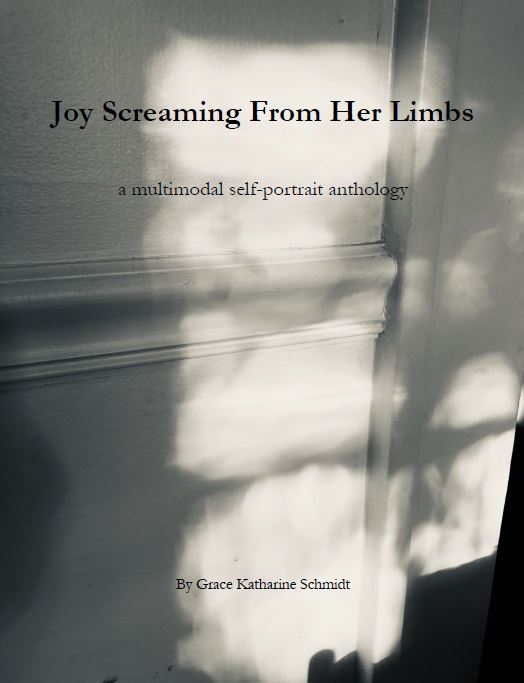
Due to classes being pushed online for the remainder of the semester, one of the projects for one of my graduate courses was cancelled, but I had been so excited about it beforehand that I asked my professor if I could do it anyway, and she said yes! So, I wrote a multimodal self-portrait anthology that combined poems I had written this semester, works by other poets that have inspired me, and drawings I’ve done. I’ve titled it Joy Screaming From Her Limbs and I am extremely proud of the work I’ve done for it. If you are interested in reading it, you can click here or download it below!

In addition to writing more poetry, I’ve also had the new experience of teaching poetry virtually through Zoom. I was really nervous to not only be teaching on a subject I’ve never taught on before, but also on a platform that I am not used to using; however, once I did it, it felt great to get to teach again!! The student I worked with—a little boy in 1st grade who I’ve been nannying since he was 2 years old—did such a great job and it was obvious how much he enjoyed getting to write poetry. I think it would be even better if we are able to continue our virtual learning together, so that we could improve and expand upon it more! If you’re interested in my Zoom teaching session with my best almost-7-year-old friend, please check out the video below!

What I love about teaching poetry is how accessible it is to all students, no matter their level of skill in literacy or their background. The short lines, the line breaks, and fewer words on the page make poetry less intimidating to a student who might be hesitant in literacy instruction, without “dumbing it down” or taking away value or meaning from the poem. I highly recommend taking a look at a video, embedded below, by Jason Reynolds about the power of poetry for students who are struggling or reluctant to read or write.

As National Poetry Month comes to an end, if you are interested in some resources for teaching, reading, or writing poetry, I have included some of my favorites below.

The Anderson Reading Clinic at Appalachian State University: Literacy Casts

The Poem Farm

Poetry for Children

No Water River: The Children’s Poetry Place

We Are Teachers: 38 Essential Poetry Books for Kids in Grades K-12

I would like to end this post with a poem:

Poetry

Thank you,
poetry,
for
never
giving up on me.

Thank you,
poetry,
for
your soft words
and
your loving smile.

Thank you,
poetry,
for
inviting me in
and holding me
close.

Poetry Reflection

Don’t be polite.
Bite in.
Pick it up with your fingers and lick the juice that
may run down your chin.
It is ready and ripe now, whenever you are.

You do not need a knife or fork or spoon
or plate or napkin or tablecloth.

For there is no core
or stem
or rind
or pit
or seed
or skin
to throw away.

– “How to Eat a Poem” by Eve Merriam

I love this poem by Eve Merriam, “How to Eat a Poem,” because what it is saying about poetry is that it is consumable, it is ready for you, it isn’t polite (and neither should you be). Readers should feel free to delve into poetry, headfirst and unafraid. In this post, I want to examine my personal feelings about poetry, and how those have an impact on the way that I will teach it in my classroom.

Reading Poetry

I love reading poetry because it is so open and deep and can look like so many different things. It can be beautiful or angry, raw or delicate, melancholy or exuberant, structured or free, simple or complex. Poetry allows its readers to connect deeply to its contents and make their own connections or inferences about what its verses mean.

How Do I Know When I’ve Read a Really Good Poem?

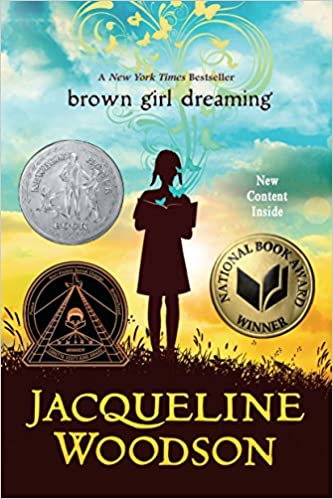
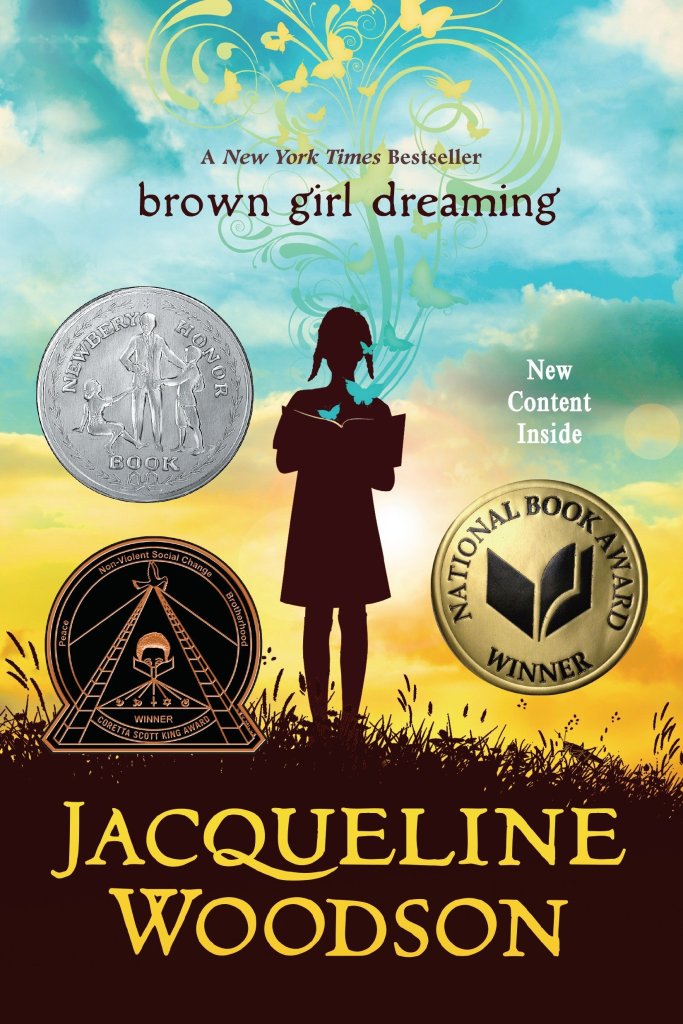
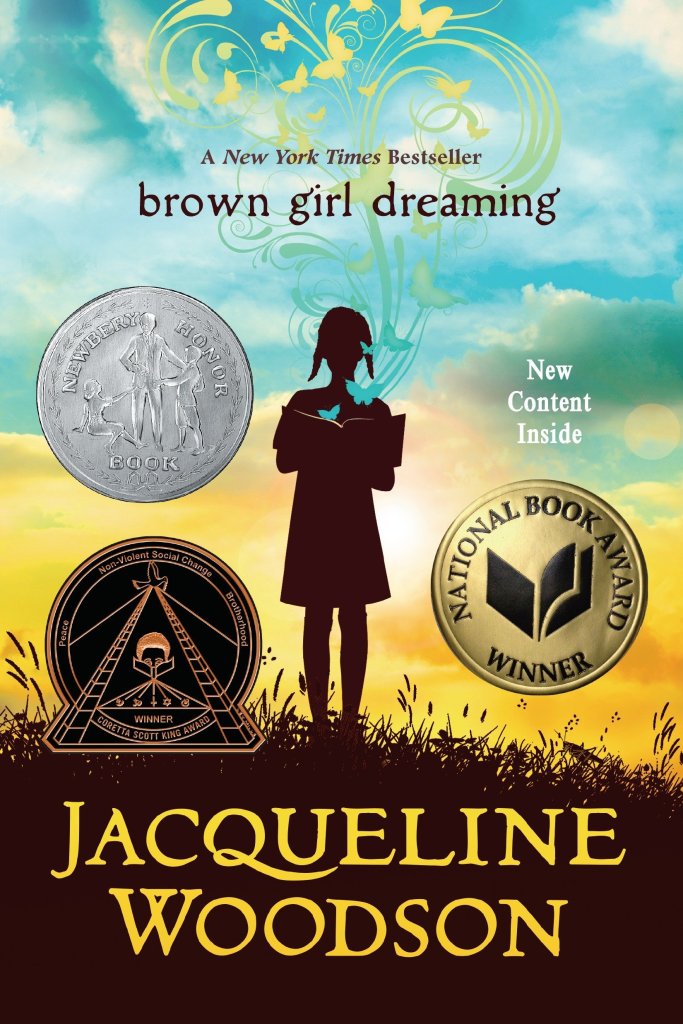
I know when I’ve read a really good poem by the way it makes me feel—it gives me some sort of emotional reaction, whether that is a positive or a negative feeling. It sort of hits you in the gut. It makes you think about life in some way: your life, others’ lives, Life in general. The words used in the poem are a good indicator, as well: are they commonplace, passive, or weak; or are they vibrant, strong, and taking an active voice? A good poem uses those strong verbs and adjectives to illustrate a picture in the reader’s mind—it is obvious that the poet put a lot of thought into each word they wrote. The poet uses different senses to help the reader feel like they are in the poem. Take, for example, the poem “as a child, i smelled the air” by Jacqueline Woodson in brown girl dreaming (2016):

Mama takes her coffee out to the front porch
sips it slow. Two steps down and her feet
are covered in grass and dew.
New York doesn't smell like this, she says.

I follow her, the dew cool against my feet
the soft hush of wind through leaves
my mother and I
alone together.

Her coffee is sweetened with condensed milk,
her hair pulled back into a braid,
her dark fingers circling her cup.
If I ask, she will hold it to my lips,
let me taste the bittersweet of it.

It's dawn and the birds have come alive, chasing
each other from maple to pine and back
to maple again. This is how time passes here.
The maple will be bare-branched come winter,
Mama says. But the pines, they just keep on living.

And the air is what I'll remember.
Even once we move to New York.

It always smelled like this, my mother says.
Wet grass and pine.

Like memory.

Sometimes the poem is a puzzle or mystery or adventure that the reader is meant to decipher. Even the breaks between lines can make for a good poem—with thoughtful placement, breaks in a poem, whether line to line or stanza to stanza, give pause to the reader in their reading of the poem… and those pauses are what make the reader think more deeply about what they are reading, creating stronger connections and imagery.

Writing Poetry

In addition to reading poetry, I also love writing it. As I mentioned above, poetry can look like many different things, and writing poetry provides me with a way to write whatever is on my heart in a way that is unlimited. One thing I am working on in my writing of poetry, however, is expanding my understanding of types of poetry; I know about haikus and free verse (free verse is my favorite kind of poetry), but I feel limited in my knowledge of other forms, such as limericks, sonnets, blank verse, and others. As I continue to expand in my poetry abilities, I hope to learn more about these and other types of poetry.

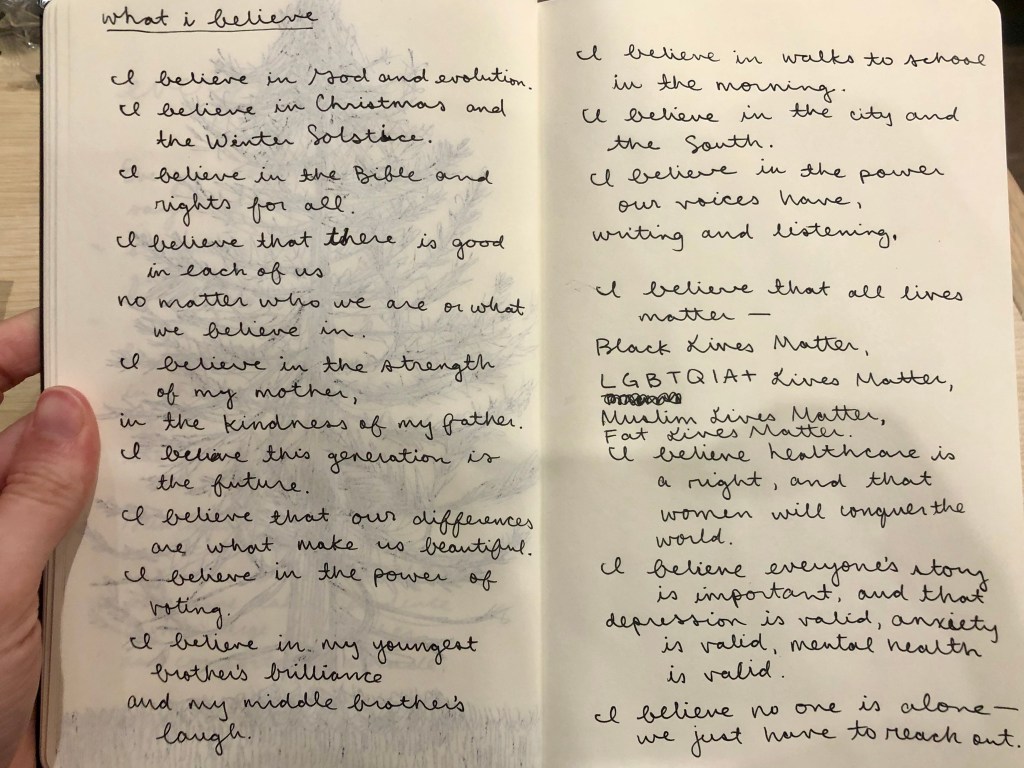
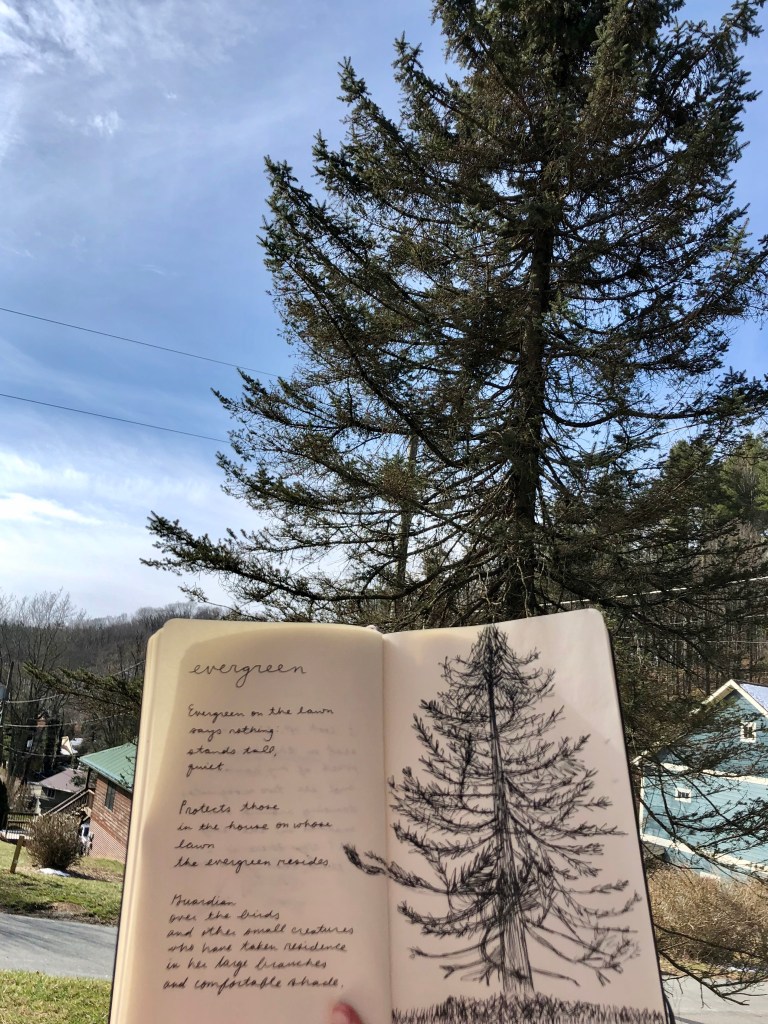
I also really enjoy writing imitation poems, which are poems that are written from studying other existing poems and adopting its form for a writer’s own personal writing. I find such inspiration in reading mentor poems and using their form to write my own poetry. I have included two of my most recent examples of some imitation poems below:

“what i believe” poem, inspired by Jacqueline Woodson’s poem of the same name, from brown girl dreaming
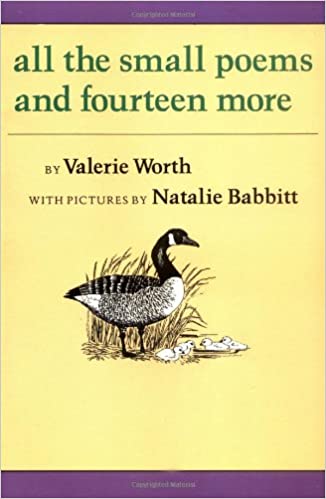
“evergreen” poem, inspired by Valerie Worth’s poem “grass,” from all the small poems and fourteen more

Teaching Poetry

I am extremely excited to teach poetry in my classroom. Because I enjoy reading and writing poetry so immensely, I hope to convey that excitement to my students and get them as excited about it as I am. I will admit, however, that I am definitely nervous about it, too! As I said, I feel as though I do not know enough about various types of poetry like blank verse and limericks, and at this point I am nervous to attempt to teach it to my students. I do find it to be very important for my students to learn about, as it is such a great medium for expressing oneself; however, I do feel that I need to learn more about those poetry types before I begin teaching students about them.

Creating a “Poetry Environment” in My Classroom

As I mentioned, I hope to convey my admiration for poetry to my students in my future classroom to get them as pumped up about it as I am. I think a large part of teaching any subject or topic is how enthusiastic about it a teacher is; however, there is obviously more to it than being excited. I hope to invite students to the poetry writing process and make them feel welcomed into its form, in order to create the “poetry environment” that I desire in my classroom. I plan to do this by reading poetry with my students each day, poetry they can relate to and which provokes an emotional reaction within them. I want to remind my students constantly that their writing is important and that poetry can provide them with so much freedom of expression. I want students to see the value of poetry and for them to feel excited about reading and writing poetry, not just in our classroom but also in their own lives as well.

References
How to eat a poem by Eve Merriam. (n.d.). The Nellen Family Jewels. https://www.tnellen.com/cybereng/poetry/eatpoem.html
Woodson, J. (2016). Brown Girl Dreaming (2nd ed.). New York, NY: Puffin Books.

What Makes for a Good Story?

“Maybe, I am thinking, there is something hidden

like this, in all of us. A small gift from the universe

waiting to be discovered.”

“hope onstage,” brown girl dreaming, Jacqueline Woodson

As I struggled to figure out how to start this blog post, falling into the same question Calkins (2006) refers to students asking, “where do I start?,” I began thinking back on a short essay I wrote in a theatre class my sophomore year of college, called My Creative Process: Rituals of Preparation. I started off this essay with the words: “Right now I am thinking about what the best way to start this essay is.” It’s funny how, even with so much practice writing, my process of unknowing how to start remains the same. Luckily for me, in the span of my almost 20 years of writing practice, I’ve gained a few tricks up my sleeve for getting started and creating a lead to “grab, pull, or yank” (Calkins, 2006) my readers into my stories: such as starting off a story with an anecdote that takes the reader into the past, just like this post!

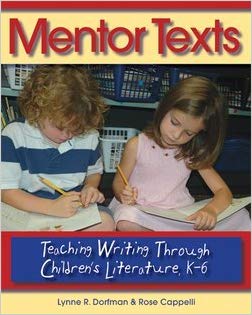
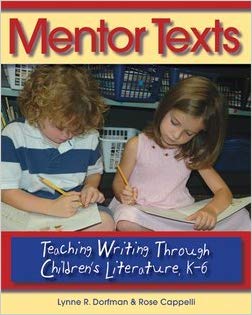
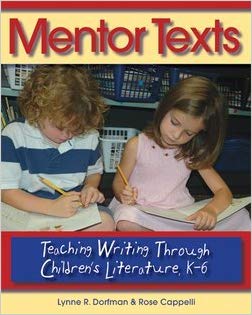
Lester Laminack, in his foreword to Stacey Shubitz’s book, Craft Moves: Lesson Sets for Teaching Writing with Mentor Texts (2016), states that “basically anything in print can be studied closely—using a lens for ‘How and why did they do that?’—to extend your repertoire of craft moves” (p. viii). Young writers need to study text in many forms, to build up those craft moves or “tricks up their sleeve.” As Dorfman and Cappelli put it in Mentor Texts: Teaching Writing Through Children’s Literature, K-6 (2007), “Mentor texts provide road maps for students to follow” (p. 124). I use mentor texts to this day to imitate writing and use strategies of professional authors to improve my own writing all the time.

But what makes a story good? Readers want to be pulled in with the lead of the story, “the first sentence, the first paragraph, or the first several paragraphs that begin the story” (Dorfman & Cappelli, 2007, p. 107). Some readers decide after reading the very first page of a story whether they want to continue or not; some flip to the back of the book to determine if it’s worth their investment. Dorfman and Cappelli discuss how too often, students don’t know how to control time in their writing—they start with too much time before the main event, they expand the story over too much time, or they can’t tell where the story should end.

To begin to show students how they can explode a small moment or span a larger period of time through focusing on one essential moment to the next, students should internalize the use of the traditional beginning, middle, and end of a story. Chapter 5 of Craft Moves: Lesson Sets for Teaching Writing with Mentor Texts (Shubitz, 2016) teaches us about fiction lesson sets using what Shubitz calls “power craft moves,” of which Shubitz claims that any book we use as a mentor text must have at least six. Some of those power craft moves (Shubitz, 2016) I want to focus on include:

  • Lead – “A good story needs a lead that hooks the reader. One way writers draw their readers into their stories is by comparing and contrasting emotions, which shows the complexity and oppositional pull of characters’ thoughts. This creates an immediate conflict, which sparks interest in what will happen” (p. 60-61).
  • Dialogue – “Dialogue is one way writers add details to the plot and expand the relationships between characters while also moving the story forward” (p. 59).
  • Ending – “A circular ending is one where the action of the story returns to the themes mentioned at the beginning. Essentially, the story ends where it began” (p. 60).

If we want students to internalize good story telling, they should become familiar with these power craft moves and learn to incorporate them into their own writing. In addition, teachers must find good mentor texts that highlight these strategies!

Six-Word Memoirs

Another great way to get students inspired in their writing is to try out six-word memoirs. Plenty of students have had the prompt to write a story about their lives—it’s a lot easier to write an entire story or even paragraph about one’s life—but how many will have summed it up in only six words? Having a limited word count places much more meaning on each one, and “every word is on trial” (Saunders & Smith, 2014, p. 602). With students, there are three goals of writing six-word memoirs that Saunders and Smith discuss in their article, “Every Word is on Trial: Six-Word Memoirs in the Classroom” (2014):

  • Promote writing for the sake of expression,
  • Reinforce tenets of the writing process, and
  • Engage students in authentic use of technology, culminating in published work on the class blog.

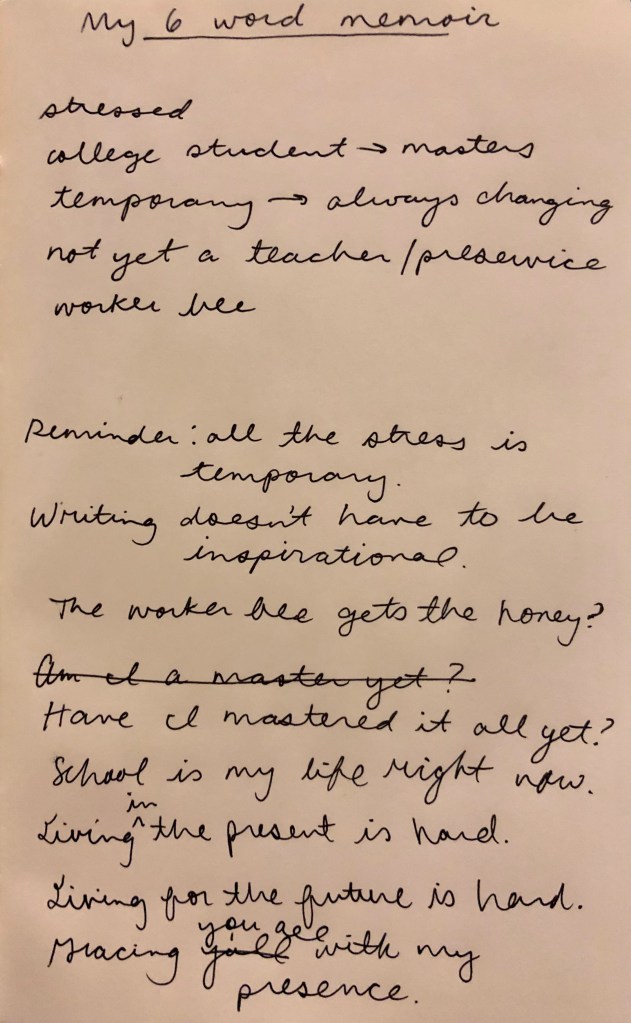
Saunders and Smith also say that employing six-word memoirs as a teaching tool should “help students define who they are as individuals” and help students “consider how these attributes affect the community around them” (p. 601). For an example of what drafting a six-word memoir might look like, take a look inside my Writer’s Notebook below:

My writing sample above shows exactly what students should see as they write in their own Writer’s Notebooks: notes at the top of things to maybe include, sections crossed out, and words inserted. When modeling writing, teachers must show students the messy process of writing—and it will get messy! I haven’t chosen my favorite sentence yet for my six-word memoir, but I think that’s okay. Writing is a process, and an author is not always truly happy with what they write, even when it is published! It is a wonderful thing to come back to a piece of writing and revise and improve upon it. Just listen to Jacqueline Woodson, author of brown girl dreaming (2016) and other books, talk about her own writing process and how revision is a natural stage of writing, in this video “Why I Write” (2018):

Skip ahead to 3:50 to hear Woodson talk about how many times she revised brown girl dreaming.

As I finish this post, I want to come back to the end of that essay I wrote as a college sophomore: “As I went along I found a direction in my writing, and began enjoying what I was writing.” If we lay out the foundational groundwork of writing strategies for students, I hope that they will develop this sense of authorship with their writing that I did with mine.

References
Calkins, L. M. (2006). Revising leads: Learning from published writing. In A guide to the writing workshop, grades 3-5. Portsmouth, NH: Heinemann
Dorfman, L. R., & Cappelli, R. (2007). Chapter 5: Creating powerful beginnings and satisfying endings. In In Mentor texts: Teaching writing through children's literature, K-6 (pp. 99-132). Portland, ME: Stenhouse Publishers.
References
National Council of Teachers of English. (2018, October 15). Why I write: 2018 National day on writing [Video]. Retrieved from https://www.youtube.com/watch?v=tE-dwp9bfeA&feature=youtu.be
Saunders, J. M., & Smith, E. E. (2014). Every word is on trial: Six-word memoirs in the classroom. The Reading Teacher67(8), 600-605. doi:10.1002/trtr.1267
Shubitz, S. (2016). Craft moves: Lesson sets for teaching writing with mentor texts.
Woodson, J. (2016). Brown Girl Dreaming (2nd ed.). New York, NY: Puffin Books.

Delving Deeper

“…EVERY kid has a story—many stories, in fact. And that is what a personal narrative unit is all about. It’s about honoring the experiences that kids bring with them to your classroom every day (the good, the bad, and the ugly experiences too). It’s about saying ‘YES! Minecraft IS exciting to hear about!’ ‘YES! I do want to hear another story about walking to school in the morning!’ ‘YES! Please write about the big fight, the mistake you made, the trouble you got into.’ ‘YES! YES! YES! You do have stories to tell. Yes, your real true life, your lived experience is worthy. Write it.'”

-Beth Moore, Two Writing Teachers, “Why Narrative Writing Matters” (2015)

Every kid has a storyand those stories deserve to be heard. It is fundamental for children to write personal narratives because it shows them they have a voice and that voice is important. But how can we help our students delve deeper and find writing topics that move them forward in those personal stories? As we know, not all students will have the same experiences as one another, and certainly not the same as ourselves, but they do all have experiences to write about: “getting up in the morning, getting dressed, coming to school” (Moore, 2015). As teachers, it is our job to focus in on those small moments or experiences, zoom in, and bring out all the details.

There are many ways teachers can “encourage young writers to uncover the real story they want to tell as they write” (Dorfman & Cappelli, 2007). As I discussed in my last blog post, students can create heart maps to unearth their treasure chests of ideas, their writing territories. Once writers see that they do, in fact, have things to write about, it is time to narrow down the topic and tell their story. This might be called a “small moment” narrative story.

My Small Moment Narrative Story

In Mentor Texts: Teaching Writing Through Children’s Literature, K-6 (2007), Dorfman and Cappelli discuss how students can write about one important moment in time, “exploding” that moment through the use of tools like “snapshots, ‘thoughtshots,’ appealing to the senses, and lots of detail” (p. 79; more on these later in the post). The teacher can introduce small moment narrative stories to students by modeling their own. Read my own small moment story below:

The Time I Fell On My Face

My class was walking to the gym when it happened. It was a dreary November day and all the children were getting excited about winter break. On the walk from my kindergarten classroom to gym, we had to walk outside on the sidewalk because the buildings didn’t connect. Walking one by one, I was in the middle of the line when I fell. Before I knew what was happening, I felt myself trip over my own feet and fall on the sidewalk, face first. Blood was everywhere: my face, my knees, my hands, all scraped up. My teacher called my mom, who came to school later and picked me up to take me home. I was bandaged up, with Band-aids next to my right eyebrow, on my nose, and on my chin. Poor little Grace! The worst, but maybe the funniest, part of the story? Santa came to visit school the next week to take pictures with the kindergartners, and I had to get my picture with Santa with Band-aids all over my face!

While there are many times I have fallen on my face in my life (an embarrassing amount), I have narrowed my writing territory down to this one small moment that happened in probably less than five minutes, and expanded upon it to describe to the reader the trauma I felt as a kindergartner.

What I think is important to point out here is that these small moment stories do not have to be written in paragraphs like mine above is. For example, in brown girl dreaming (2016), each poem Jacqueline Woodson writes tells the story of a small moment in time. Just read “sunday afternoon on the front porch” (p. 199) and you’ll see how Woodson stretches the small moment of one Sunday afternoon with her grandfather so that readers see its single moment significance. Be sure students know that they can tell their stories in any medium they like: their writing is never limited.

Strategies to Slow Down Time

Above, I referred to several powerful tools writers can come back to to develop the content of their narratives and slow down time: “snapshots, ‘thoughtshots,’ appealing to the senses, and lots of detail” (Dorfman & Cappelli, p. 79). Because what makes any story enjoyable for its readers is the details, which are essential to good writing. Slow, specific scenes are built up through the use of anecdotes, sensory details, dialogue, and more. These might be things like “thoughtshots,” which are the addition of character thoughts to provide clarity and depth to a moment; or the use of dialogue to open up a scene and “learn more about the characters from what they say, how they say it, and what others say about them” (p. 72).

Additionally, many young writers often attempt to tell a story through, essentially, list making. “I did this, then this, then this, then this happened.” Adding descriptive details can move students away from this, so that their readers can more easily make connections and visualize the story in their minds. Students need experience using rich descriptions to write about the people, animals, objects, and places mentioned in their narratives. Just as strong sensory images (i.e., photographs, music, etc.) can help writers unearth memories to write about, writers need to appeal to the senses to bring the reader in closer. And these sensory descriptions don’t just stop at sight; writers should incorporate all five senses in their descriptions. Just read how beautifully Jacqueline Woodson incorporates different senses to help her readers visualize the scene in the first stanza of “gunnar’s children” (p. 50):

At dusk, just as the fireflies flicker on, my grandfather
makes his way
home.
We see him coming slow down the road,
his silver lunch box bouncing
soft against his leg. Now,
as her gets closer, we hear him
singing

Isn’t that so romantic? Woodson’s appeal to the senses is what makes this poem (and many of her others) so powerful.

“Your Turn” Narrative Writing Minilesson

Finding the Point of Your Story

Mentor Texts (2007) is filled with excellent “your turn” minilessons to help students write more detailed and interesting stories. One lesson that I briefly mentioned in my last blog post was “Finding the Point of Your Story.” Many books and stories share similar topics or themes (i.e., family, friendship, home, etc.), but each one has a different message or “point” the author is trying to get at.

Download the PDF below to view the lesson I created with one of my graduate colleagues, Morgan Payne, to help students narrow a topic to find the “point” of their narrative stories, using the 2001 picture book The Other Side (also by Jacqueline Woodson!).

I have included just a sampling of strategies young writers can use to find the stories that are important to them and delve deeper. You can also check out a series of lessons/daily minilessons for strategies that one of my graduate professors, Dr. Frye, as come up with by downloading the PDF below.

What are some of your favorites? Do you have others I should know about? Leave a comment!

References
Boelts, M. (2012). Happy like soccer. Somerville, MA: Candlewick Press.
Dorfman, L. R., & Cappelli, R. (2007). Chapter 4: When writers use a magnifying lens. In Mentor texts: Teaching writing through children's literature, K-6 (pp. 69-97). Portsmouth, NH: Stenhouse Publishers.
Moore, B., & Two Writing Teachers. (2015, October 7). Why narrative writing matters. Retrieved from https://twowritingteachers.org/2015/10/07/why-narrative-writing-matters/
Woodson, J. (2001). The other side. MA: Fontana Press.
Woodson, J. (2016). Brown girl dreaming. MA: Penguin.

Writing Territories & Where I’m From

“Good writing will come from finding fresh new things to say about a topic and from knowing how to write about the topic in different ways for different audiences.”

Mentor Texts, p. 47 (Katie Wood Ray, Wondrous Words)

Every good writer writes from their own experiences: things they did, things that happened to them, things they read from a mentor text. In chapter 3 of Mentor Texts: Teaching Writing Through Children’s Literature, K-6 (2007), Dorfman and Cappelli discuss these “writing territories,” which they describe as “the treasure chests of their hearts and minds where they store precious memories about people, places, events, and objects” (p. 48). These writing territories are broad concepts or topics that anyone can write about, but can produce many, many story seeds—”the kernels of rich ideas that can grow and blossom into narratives, poems, letters, and articles” (p. 48)—that are unique to each individual.

For example, some writing territories I am familiar with:

  • family
  • friends
  • home
  • pets
  • things I am good at
  • animals

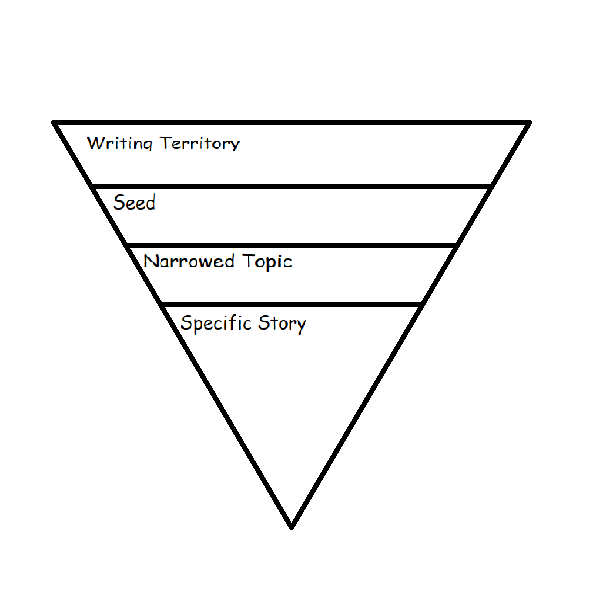
As you can see, while these topics have specific meaning to me, they are relatable to any writer. It is those specific seeds we find from our writing territories that we choose to write about. Once we have some writing territories to utilize up our sleeves, we must narrow our topic down to tell a special and unique story. Dorfman and Cappelli refer to an inverted triangle graphic organizer (p. 51-52) writers can use to narrow a chosen territory, zooming in on the one story they plan to write about on one particular day.

Blank inverted triangle graphic organizer

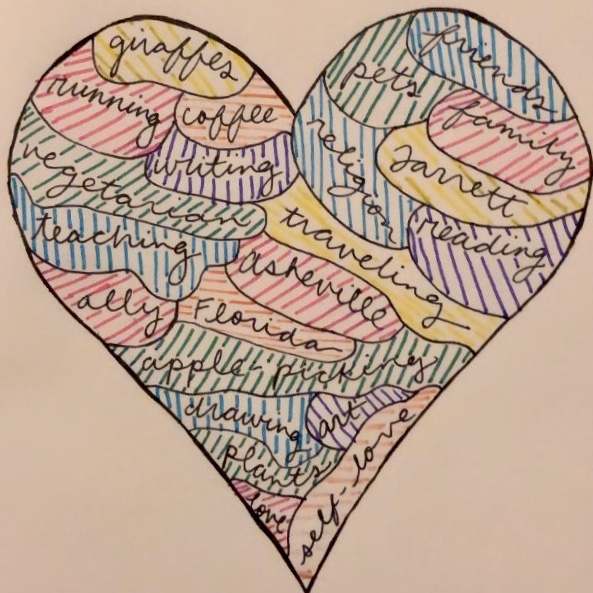
One way to find writing territories is by creating a heart map. This is a visual display of the things from a writer’s heart that they care deeply about—memories of family, where they grew up, people they’ve met, and more.

My heart map

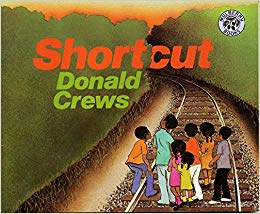
Alternatively, as I’ve mentioned in my previous two blogs, using a mentor text always helps us to think of topics for our writing, especially when a teacher helps give us a prompting question to think about in relation to the text. Stories generally have a “point” they want to get across—this could be found in the title, in the last line of the text, or inferred throughout the reading. Teachers can use this “point” to come up with a probing question for a classroom of writers. For example, the #OwnVoices picture book Shortcut by Donald Crews tells the true story of Crews’ own story about taking a shortcut home along the train tracks and getting trapped between the oncoming train and safety. After reading this book with the class, the teacher can ask probing questions such as:

  • Have you ever done something foolish or dangerous (maybe to try to avoid getting in trouble)?
  • Were you ever worried about something and everything turned out okay?

Students can do a quick write in their Writer’s Notebooks before having a group discussion or using their quick write as a first draft for a longer story.

Like my previous post, I’ve got to mention brown girl dreaming (2016) by Jacqueline Woodson. I’ve gotten through Part II, “the stories of south carolina run like rivers” and so far, it’s my favorite section of the book. There’s so much to love! The whole time I was reading it I kept thinking of the ways in which I could relate to Woodson’s experiences: coming back to a home that wasn’t really home at all because everyone else has gone away (p. 46-47), southern cooking, the smells of home (p. 95), changes (p. 108-109), family dynamics (p. 122-123), and why we tell stories (p. 134).

The whole section tells stories about Woodson’s experiences growing up as an African American in the South during the 60s, specifically living with her grandparents in Greensboro. It is reminiscent almost of an extended version of a “Where I’m From” poem, like this one by George Ella Lyon. Students can draw inspiration from Lyon and Woodson alike and write their own “Where I’m From” poems, like the one I wrote below:

Where I'm From
I am from scratching posts,
         from The Princess Bride and Circle in the Square.
I am from the pictures all over the walls
         (Scattered, beautiful,
         it feels like a home.)
I am from the cosmos in the backyard,
         the morning glories
         that my mother would preen over like they were her children.

I'm from the Chinese food and A Christmas Story
         from Kristi and Ken.
I'm from the smart alecks
         and the have-to-be-rights,
from Don't chew with your mouth open! and You are loved.
I'm from atheism turned agnosticism,
         to finding my own spirituality and faith.

I'm from Orlando and Beer City, USA,
         mashed potatoes and tomato sandwiches.
From the mom my mother lost
         at 10 to an aneurysm,
the hip my father had replaced
         as a teenager.

In the photo album my parents
         kept to show my brothers and I where we came from.
I am from those memories—
         sweet, childhood play—
         knowing I am loved.

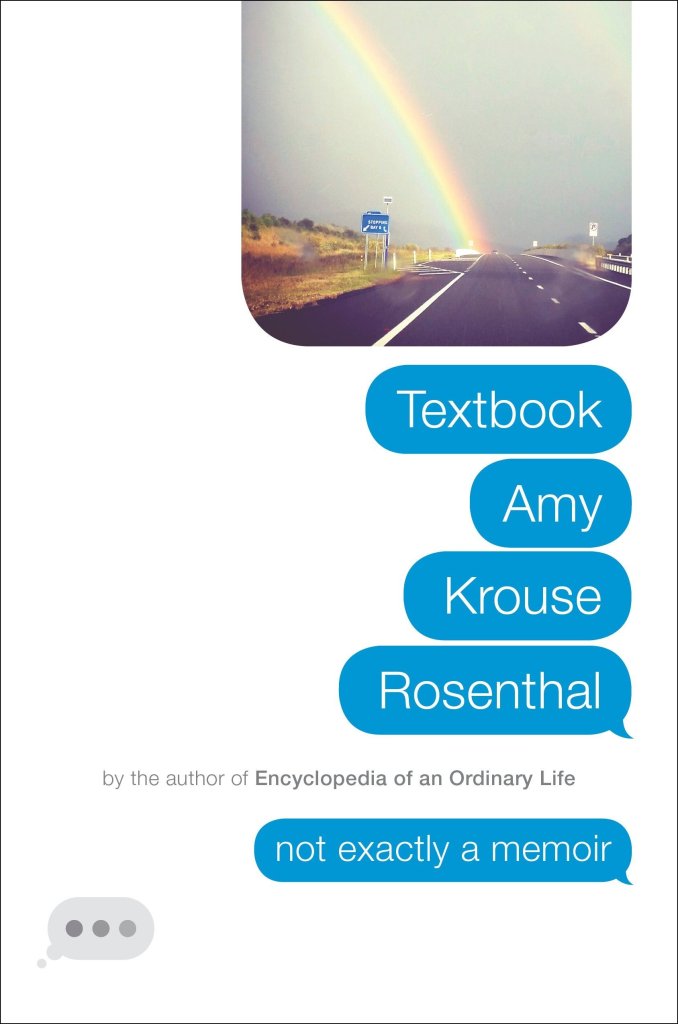
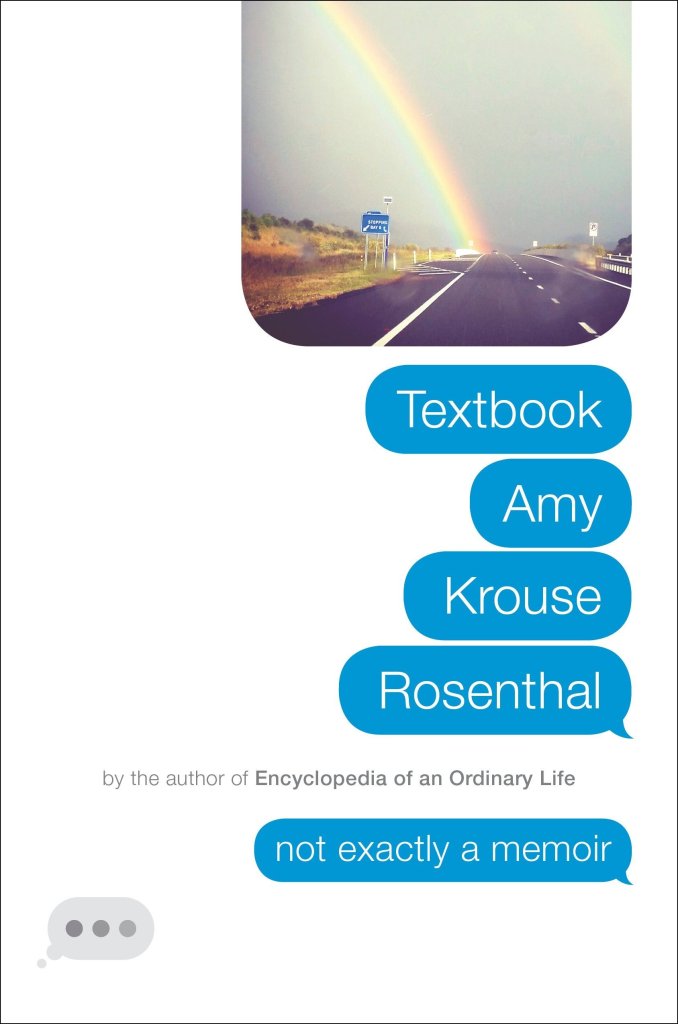
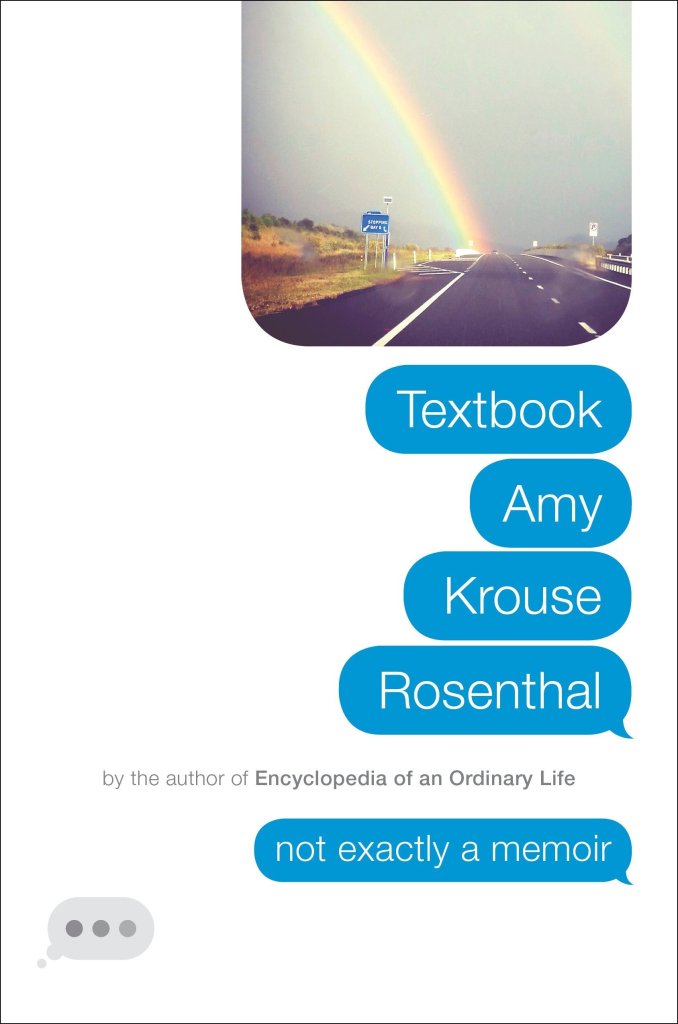
I want to end this post with a quote from Textbook Amy Krouse Rosenthal (2016) that I think summarizes all the readings and writing ideas I have mentioned really nicely:

“Just look at us, all of us, quietly doing our thing and trying to matter. The earnestness is inspiring and heart-breaking at the same time.”

Textbook Amy Krouse Rosenthal, p. 121

I want my students to know that what their actions and their voices really do matter. I want them to know that their writing is important and that their stories have value. I think this is what we are all striving for as teachers of writing.

References
Crews, D. (1992). Shortcut. New York, NY: HarperCollins Publishers.
Dorfman, L. R., & Cappelli, R. (2007). Chapter 3: What are you really writing about? Discovering the inside story. In In Mentor texts: Teaching writing through children's literature, K-6 (pp. 47-68). Portland, ME: Stenhouse Publishers.
Rosenthal, A. K. (2016). Textbook Amy Krouse Rosenthal. New York, NY: Penguin Random House.
Woodson, J. (2016). Brown Girl Dreaming (2nd ed.). New York, NY: Puffin Books.

Social Studies: What Makes Us Who We Are?

Some guiding questions (Facing History and Ourselves, n.d.) to keep in mind while reading this blog:

  • What is identity?
  • What factors help shape who we are?
  • How do our names relate to our identities?

In brown girl dreaming (2016) by Jacqueline Woodson, Woodson shares poems about her childhood and growing up as an African American in the 1960s and 70s. From the beginning of “february 12, 1963,” readers are drawn in by Woodson’s gorgeous writing. The first seven pages of the New York Times bestseller demonstrate an exploration of identity for Woodson: when and where she was born, the context surrounding her birth, and how she got her name. She goes on to describe the people and histories that shaped who she is, but these first seven pages immediately allow the reader to think about the importance of her name, how her name connects her to her family and the historical, cultural, or ethnic stories connected to our names (Frye, n.d.). One of my favorite sections of verse from Woodson’s poem “a girl named jack” (p. 6-7) says,

Name a girl Jack, my father said,
and she can't help but
grow up strong.
Raise her right, my father said,
and she'll make that name her own.
Name a girl Jack
and people will look at her twice, my father said.

Although Woodson was ultimately named Jacqueline and nicknamed Jackie instead of Jack (to her father’s dismay), what I love about these lines is that you can truly get a sense of how much a name can mean to a person. Woodson’s father Jack clearly holds a strong connection between his name and his identity, which he wanted to pass on to his daughter. When reading this text with students, have them focus on the following questions (Frye, n.d.):

  • What does the author tell us about names in this piece?
  • How/why are the names important?
  • How did Jacqueline get her name? What are stories connected to the name?
  • Are there any cultural markers connected to the name? If so, how do they shape the story?
  • How does Jacqueline feel about her name? How does the author write about this? Do these feelings change with time?
  • Does the passage reveal how the name shapes the character’s identity? Explain.
  • How does the author use voice: child’s voice, adult-looking-back-in-time voice, adolescent’s voice, third-person omniscient, etc.?
  • Does the author use writer’s craft and vocabulary effectively? How?

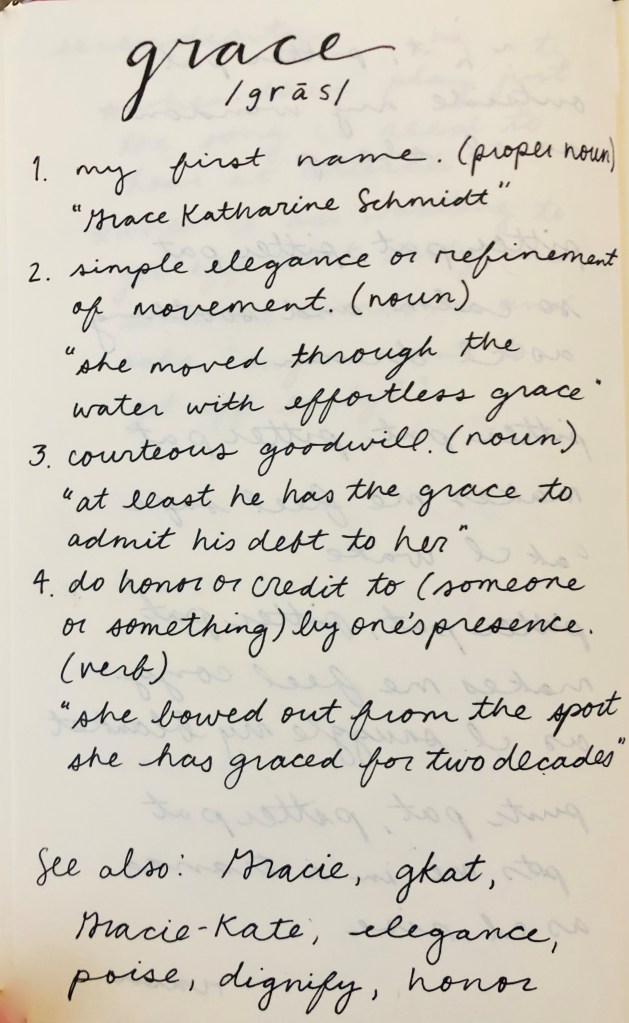
In response to reading “a girl named jack,” I have thought about these questions listed above as well as what my name means to me, and created this entry in my Writer’s Notebook about my first name, Grace:

This entry, to me, is only a start in thinking about all the meaning that my name possesses. I am excited to continue my journey in writing about my name!

In addition to helping students think about their names in relation to their identities, doing a read-aloud of pages 1-7 from brown girl dreaming might trigger students’ thoughts, unlock memories, and remind children that the things they have to say are important and interesting. In chapter 2 of Mentor Texts: Teaching Writing Through Children’s Literature, K-6 (2007), Dorfman and Cappelli encourage teachers to use read-alouds like brown girl dreaming to inspire those thoughts, feelings, and memories that children have. They say, “Writers should always have a place where they can record their writing ideas so they are not lost when it comes time for writing workshop” (p. 21). The use of a mentor text is not only to mimic the techniques of good writers, but also to be inspired by them and to write stories that come from the “treasure chest of opportunities” (p. 38) that a mentor text provides.

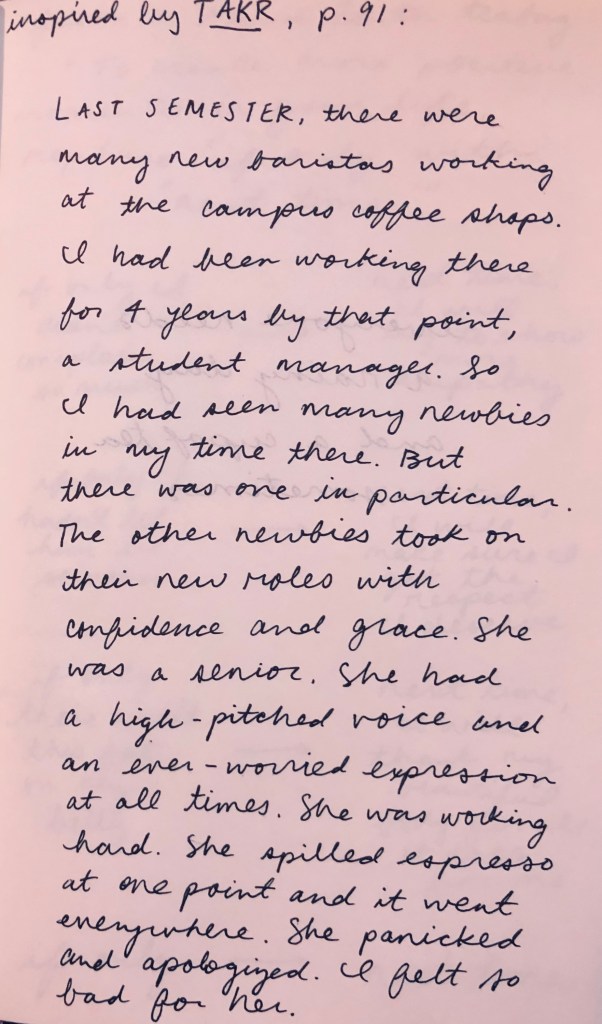
Reading from the unit “Social Studies” in Textbook Amy Krouse Rosenthal (2016) in conjunction with brown girl dreaming and thinking about identity is quite perfect. In this unit, Rosenthal writes about different “social studies” she has examined over the years: why she has left an individual honey packet peeking out from under the passenger seat of her car (p. 63), the “two stages of life” of whether or not one throws out the empty box after taking the last granola bar (p. 66-67), the mundane highs and lows of life (p. 79), or the time delay between experiencing some sort of bewilderment and coming to a resolution about said bewilderment (p. 88). Without explicitly stating so, Rosenthal is inspecting social oddities and the factors that shape a person. Even if I don’t relate deeply to one of Rosenthal’s entries, I can see myself within her studies and form my own connections, and I think any reader could do the same. Below I have included one such connection triggered by reading Rosenthal’s study on page 91, and the resulting entry in my Writer’s Notebook:

What is great about all of these readings is that doing so sparks thoughts, ideas, and memories to write about, just as Dorfman and Cappelli suggest. Although Textbook Amy Krouse Rosenthal isn’t written as a text for children, doing a read-aloud of appropriate excerpts from the book or reading brown girl dreaming are excellent mentor texts to spark those thoughts and memories. They invite readers to become writers, and create a sense of urgency for students to draft entries in their own Writer’s Notebooks. My last blog entry includes examples of such invitations. Showing students their stories are interesting and valued helps them feel invited and encouraged to record those stories.

References
Dorfman, L. R., & Cappelli, R. (2007). Chapter 2: Digging for treasure: Discovering personal stories by connecting with read-alouds. In In Mentor texts: Teaching writing through children's literature, K-6 (pp. 19-46). Portland, ME: Stenhouse Publishers.
Facing History and Ourselves. (n.d.). Lesson: Identity and names. Retrieved from https://www.facinghistory.org/resource-library/my-part-story-exploring-identity-united-states/identity-and-names
Frye, E. (n.d.). Writer’s notebook: History of a name-mini-lesson.
Rosenthal, A. K. (2016). Textbook Amy Krouse Rosenthal. New York, NY: Penguin Random House.
Woodson, J. (2016). Brown Girl Dreaming (2nd ed.). New York, NY: Puffin Books.

The Serendipity of Mentor Texts & Beginning a Writer’s Notebook

I have always been a writer, ever since I was a child. My idea of a good time was writing a silly book with my best friend about M&Ms who could talk, and their interactions with humans. I would spend free time in my room writing in my SECRET-DO-NOT-ENTER diary. My favorite part of going to an art gallery is, to this day, viewing the pieces that feature text in some way. I gain a lot from words—and putting ideas down on paper. But I do not think I would be the writer I am had I not had excellent sources to serve as mentor texts.

Mentor texts are pieces of literature that serve to help writers use the writing skills they have not yet developed. In chapter 1 of Mentor Texts: Teaching Writing Through Children’s Literature, K-6 (2007) by Lynne R. Dorfman and Rose Cappelli, they claim that “Mentor texts serve to show, not just tell, students how to write well” (p. 4). As a child, I used mentor texts on my own to influence and better my writing, and I still do. Good writers learn from other writers: “Mentor texts help writers notice things about an author’s work that is not like anything they might have done before, and empower them to try something new” (p. 3). Good writers also begin as readers, and “writers should be introduced to mentor texts first as readers” (p. 5). Mentor texts should be well-loved and familiar, and this happens when writers learn to appreciate the characters, words, rhythm, story, and message of those well-loved and familiar stories from their own reading.

As teachers, we should strive to become writers ourselves, because as Dorfman and Cappelli say, “it would be difficult to teach someone how to swim if you didn’t do it yourself” (p. 9). Teachers should use mentor texts not only with students, but for their own writing as well. This helps us engage in the same challenges that our young writers will—and then develop the same problem-solving skills that we want them to use. Once we become familiar with those strategies through our own writing, we are more readily available for guiding our students in expanding their own. Students need a teacher who writes, who enjoys writing. In addition, as Dorfman and Cappelli point out, “Sometimes students need extended time to really try out a technique before it can become part of their repertoire of strategies” (p. 13). That’s where the Writer’s Notebook comes in handy.

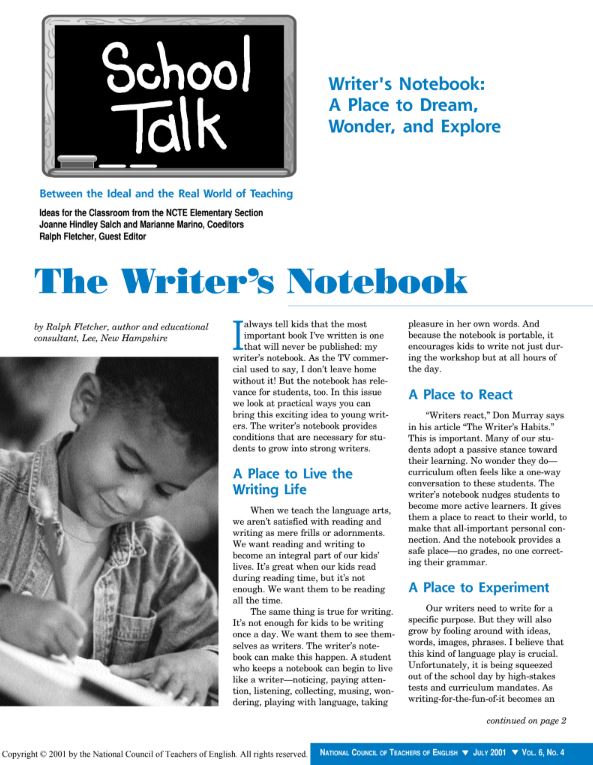
A Writer’s Notebook is a place to store ideas, enjoy language, experiment with new techniques, and develop as a writer. Ralph Fletcher wrote and edited an article in the journal School Talk titled “The Writer’s Notebook” (2001), in which he described the Writer’s Notebook as “a place to dream, wonder, and explore” (p. 1). It should be something a writer wants to write in, something they keep handy, and something they are using all hours of the day. As Fletcher writes,

Many of our students adopt a passive stance toward their learning. No wonder they do—curriculum often feels like a one-way conversation to these students. The writer’s notebook nudges students to become more active learners. It gives them a place to react to their world, to make that all-important personal connection. And the notebook provides a safe place—no grades, no one correcting their grammar.

This is a vital aspect of loving writing for our students. If students are forced into writing, particularly about topics they are uninterested in, they will learn to hate it. Developing skills through a Writer’s Notebook allows young writers to love writing. “Our writers need to write for a specific purpose. But they will also grow by fooling around with ideas, words, images, phrases” (p. 1).

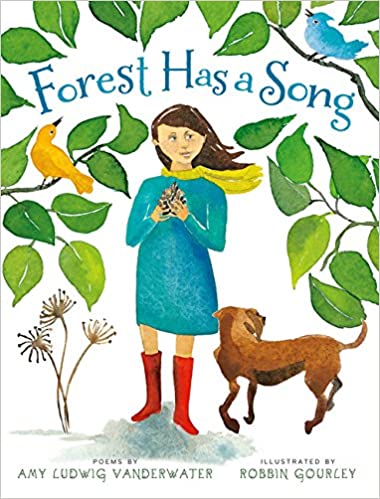
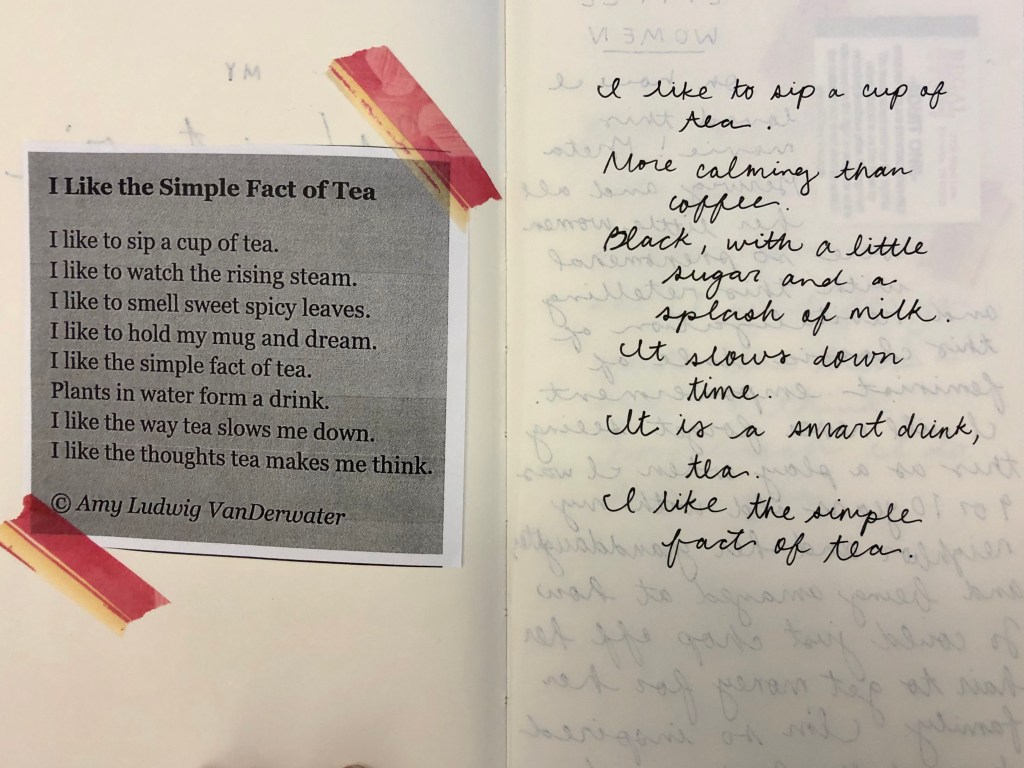
A poem in my Writer’s Notebook based on the mentor text, “I Like the Simple Fact of Tea” by Amy Ludwig VanDerwater

I have just begun my own Writer’s Notebook and I have to say I already love it. I am so excited to continue my journey with it. The Writer’s Notebook has included several invitations for writers to use in their notebooks, which I hope to get a use out of in my own. Some of these include (p. 4-5):

  • Three by Three – List three-word phrases for three minutes. Select a single word to designate a subject: summer, beach, school, etc. Get pencils ready—go! It doesn’t matter if the three-word phrases make sense.
  • Write about Your Name – Write about your name in any way you choose: who you are named after, a name you were almost given, nicknames, how you feel about your name, etc.
  • Capture What Is Important – Graham Salisbury offers this advice in Speaking of Journals: “Write…some little or big thing every day, and not stuff like ‘Today I went over to Jacky’s house and….’ No. That will be useless to you. Rather, write stuff like ‘Dad kissed me on the head today just before he left for work. He never kisses me like that, and I wonder what’s going on with him.’ Stuff like that—feelings, emotions. Good, meaty stuff.”
  • Describe Your World – A writer’s eye takes in the surroundings with keen perception. Learning to “see” means stretching to use all five senses. Stake a claim on something—your desk, the classroom, the lunch-room, your bedroom. Don’t just describe what you see, but also include the sounds, smells, and feel of the place.
  • Include Drawings and Sketches – Study something big (your backyard) or small (a daffodil just opening in spring). Make a drawing or sketch to capture the image. Then write in the empty space a description of what you see. Barbara Bash says, “I go out into an ecosystem and draw. By drawing it, I know it in a more intimate way. Even if it seems much too complicated to capture on the page, when I try to draw it I make an inner connection and understand it in a physical way.”
  • Write to a Specific Audience – Think of something you’ve been wanting to say to someone and write it in your notebook in letter form. Write as if you are speaking directly to that person. You might even create a conversation and let the person speak back to you.
  • Bits and Pieces – In Speaking of Journals, Jean Craighead George says, “It’s tough for kids to get started on journal keeping, so I suggest they bring back little things they pick up along the way—folders from a museum visit, a leaf, a dandelion—and paste them into a notebook. Then they can write their thoughts about them, what they saw and what they felt” (73).

Another excellent source of inspiration for writing in a Writer’s Notebook: Textbook Amy Krouse Rosenthal: Not Exactly a Memoir (2016) by Amy Krouse Rosenthal. I have barely even begun reading this not-exactly-a-memoir and yet I am already enthralled. Written as a “textbook” about the “textbook” (i.e., “classic”) Amy Krouse Rosenthal herself, this book includes quizzes to complete (by writing… in an actual, printed book!), cues to actually text the author, poems, pages with one sentence on them, and other narratives. This book provides its reader with many opportunities to utilize a mentor text.

LEXICO (by Oxford) defines serendipity as “the occurrence and development of events by chance in a happy or beneficial way.” Rosenthal takes a more creative and unique approach of defining through a numbered list of instances in which she has experienced serendipity (p. 24-33). My favorite of these examples is when Rosenthal describes having been at a book reading during which she decided to give away a ring of hers, has difficulty choosing which member of the audience to give said ring to, picks a woman who struck her the most of needing/wanting the ring, and tells her to pass the ring onto someone else on her birthday, April 29th… the same birthday as the woman to whom she gave it.

What I like most about Textbook so far is that it teaches writing techniques without the reader really thinking about it. It shows that writing doesn’t have to be this strict, properly formatted piece of text, but rather fun, sometimes unorganized, and creative process.

I must say, I have found all of the readings mentioned in this blog to be quite serendipitous-ly connected: through the use of “mentor texts” such as Textbook Amy Krouse Rosenthal, we can create in our “Writer’s Notebooks,” and in the process, become better writers.

References

Dorfman, L. R., & Cappelli, R. (2007). Chapter 1: Reinventing the writer with mentor texts. In Mentor texts: Teaching writing through children's literature, K-6 (pp. 1-17). Portland, ME: Stenhouse Publishers.
Fletcher, R., Salch, J. H., & Marino, M. (2001). The writer's notebook. School Talk, 6(4), 1-6.
LEXICO. (n.d.). Definition of serendipity. Retrieved from https://www.lexico.com/en/definition/serendipity
Rosenthal, A. K. (2016). Textbook Amy Krouse Rosenthal. New York, NY: Penguin Random House.

Being an Ally

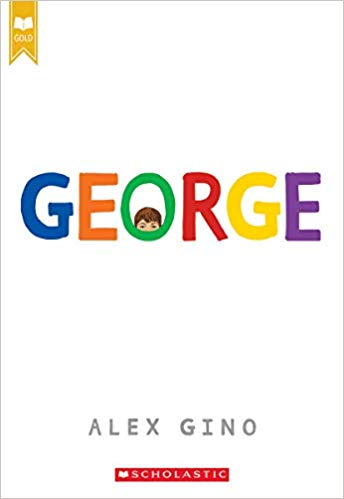
Sometimes when you are surrounded by like-minded people a lot, it is easy to forget that there are other people who do not have the same viewpoints as you. I was reminded of this when a peer in one of my graduate courses told me the other day she was not a fan of the book we just read for class, GEORGE by Alex Gino (which I wrote about in a separate blog post). After I heard this, I decided to go check out the blog post she wrote about her thoughts on the book, and I found myself very disappointed, angry, and scared for her future students. All of these feelings arose from the clearly transphobic attitude she had toward the author and the book.

In her post, she begins by saying that this book is not suitable for younger children. While I agree due to the higher level and frequency of Tier II words, it is a 790 Lexile and Reading A-Z level Z, which is appropriate for many students ages 9-11, or grades 4-6. My classmate also claims that it should “absolutely not” be available in a “public education facility,” due to content including “body parts, tampons, and porn.” I have to disagree strongly with her stance that this content is inappropriate for grades 4-6, as by this age many children are 1) curious about their bodies, 2) experiencing periods for the first time (or know a classmate who is), and 3) being exposed to these topics via the internet regardless of what books we have in our classrooms. GEORGE does not even explicitly address porn, as my peer has claimed in her post—Melissa’s older brother Scott implies that the “girl” magazines she collects are used for masturbation, before he knows that she is a girl. While I understand many teachers may feel uncomfortable discussing these topics with their students, children this age are naturally beginning to become curious about their bodies as well as their sexuality—all very natural feelings, and if we trust our students to be mature about topics like these, they will be. Would we really rather students learn about these topics via the internet, where there really is age-inappropriate content, than via a book that addresses those topics in a mature and graceful manner?

The second problem I have with my peer’s blog post is the way that she continues to misgender Melissa and call her by her birth name throughout. This is incredibly insensitive and disrespectful to anyone of the trans or queer community, who already have to fight so hard to be called by their proper pronouns. I fear for the child in my peer’s future classroom who identifies as something other than cisgender, as I know that they will not be accepted for who they are in her classroom. I can only hope that that student will have another teacher or adult ally that they can turn to.

In the second paragraph of the post, my classmate states that the book was not “authentic.” I do not really understand this claim, as you cannot really get more authentic than an own voice perspective. She continues on to say, “On page 48, it makes the comment that George must be a girl because he is good at math and hates snakes. Which again, it [sic] inaccurate. Guys are generally better at math and guys can hate snakes.” Obviously boys can be good at math and hate snakes—but that is not the point of the paragraph referenced:

“George opened her lips, but there were no words in her mouth and only one thought in her brain: No! George knew that Mom was trying to help. But George didn’t have a normal problem. She wasn’t scared of snakes. She hadn’t failed a math test. She was a girl, and no one knew it.”

(p. 47-48)

The point of this paragraph was to say that being scared of snakes or failing a math test are normal problems for children. Feeling uncomfortable in the body you were born in and nobody knowing your real identity is far more complicated. In no way was Gino saying that Melissa is a girl because she was scared of snakes and was good at math. My classmate also makes other references to GEORGE being inaccurate or inauthentic, but they are just as misunderstood as this example, so I will not go into detail on those.

The next criticism my peer discussed was the negative portrayal of the school system in the book. She says GEORGE “talks about bullying, poor and not appetizing lunches, female and male restrooms.” I am not really sure what problem she has with the mention of these things in the novel—these are real issues present in public school systems around the United States today, and the absence of these topics would be what would make this book inauthentic. Bullying continues to be an extremely concerning occurrence in schools around the nation—according to the Stop Bullying Now Foundation,

  • 60% of middle school students say that they have been bullied,
  • 160,000 students stay home from school every day due to bullying,
  • 20% of high school students say they have seriously considered suicide within the last 12 months, and
  • Bullying was a factor in 2/3 of the 37 school shootings reviewed by the US Secret Service.

Not to mention the increased likelihood that students who identify as transgender or genderqueer are at a higher risk of bullying in schools; according to the National Center for Transgender Equality,

  • 75% of transgender youth feel unsafe at school and
  • 59% of trans students have been denied access to restrooms consistent with their gender identity.

According to an article by the Daily Beast,

  • 81 percent of trans youth are sexually harassed in school and
  • By the end of middle school, 22 percent of trans students report being harassed due to their gender identity.

These unsettling statistics also leave out the disheartening fact that after schooling, transgender people are at higher rates of being attacked or murdered as well. In an article by the Human Rights Campaign, they state that “in 2018, advocates tracked at least 26 deaths of at least transgender or gender non-conforming people in the U.S. due to fatal violence, the majority of whom were Black transgender women,” and “2019 has already seen at least 22 transgender or gender non-conforming people fatally shot or killed by other violent means. We say at least because too often these stories go unreported—or misreported.”

Not talking about bullying in schools, particularly as it applies to trans and other LGBTQIA+ students, would be a disgrace. GEORGE does so with eloquence and respect. Below I have included a fact sheet on the U.S. Department of Education’s policy letter on transgender students, which includes some of the rights they are granted at school through Title IX. I highly recommend taking a look:

My classmate’s post continues by saying that, “the most inaccurate portrayal of all was on page 176”:

“The light in the east was still orange from the sunrise. The sun itself had lifted into the sky, and its rays were warm on George’s face each time she emerged from the shade of the oak tree.”

She then states, “This portrays the idea that after George comes out, that he is accepted by all and the world is such a better place. This is not true, he would face so much backlash and hatred, not be sitting there taking the sun in on his face.” While I agree that unfortunately the world is a hate-filled place, particularly toward transgender and queer people, I do not think that it is hopeless, as my classmate suggests. Many LGBTQIA+ people feel a sense of relief once they come out to friends or family, due to the fact that they are then able to express themselves and their full identity for who they are, unabashedly. There are far too many sad stories in the media about LGBTQIA+ people, and the happy ending Melissa has in GEORGE is a wonderful contrast to those dark stories. I think this is the idea that Gino was trying to get at when they wrote this sentence.

I would also like to point out here that in my classmate’s blog, when she quoted the above sentence from the novel, she censored Melissa’s pronoun “she,” which again lends to my point above the level of disrespect that comes out of my peer’s post each and every time she purposely misgenders Melissa.

Next, my classmate says that she “despised” the inclusion of the reference to an interview Melissa had seen on television with a transgender woman named Tina, who told the interviewer that “what she had between her legs was nobody’s business but hers and her boyfriend’s” (p. 46). She also says she “100% disagree[s],” and that if she were to share a dressing room or a bathroom with someone, then she “reserve[s] the right and respect to know that and reserve[s] the right to be uncomfortable with the idea.” While obviously no one is able to tell her what she can and cannot be uncomfortable with, my classmate seems to feel that her discomfort is more important than someone else’s privacy to their own body. Although my peer claims in her post that body parts are inappropriate to discuss, she seems to feel that she has a right to know what body parts everyone in a dressing room or bathroom has between their legs—which is a complete violation of someone’s privacy. No one in a dressing room or bathroom wants to pay attention to someone else’s private parts, so I do not see why my peer feels differently when it comes to someone who is transgender.

My classmate then goes on to say that Melissa felt “entitled” and “more deserving” of the part of Charlotte in the fourth grade play adaptation of Charlotte’s Web. I did not get this sense at all from reading the novel. Everyone at school told Melissa how great of an actress she was, and playing the role of Charlotte was the way that she chose to prove to her mother that she was in fact a girl. It was Melissa’s friend Kelly who willingly gave up the role of Charlotte so that Melissa could play her—no one was hurt by Melissa playing the role instead of Kelly.

My peer also says,

“I think it’s evident that George suffers from the abandonment of his father, and that took an influence on how he turned out. But then again, I see this is a choice. A choice in the fact George could have gone to therapy to get help before it reached the point he was at. I do not think he necessarily felt like he was a girl. But instead did not have a father role model to live by. He thought all of his actions seemed feminine so, yepp [sic] must be a girl. Which is inaccurate. He should have been taught that individuals carry different characteristics but it does not make them more feminine or masculine.”

In this quote my classmate claims that Melissa’s gender dysphoria is caused by the absence of her father in her life, as he and Melissa’s mother had divorced prior to the setting of the novel, rather than the fact that Melissa was born transgender. She continues,

“I feel like kids have enough pressure as is, they do not need to be posed with “am I really a girl or guy?”, that is not a question that they should ponder. I should not have students in my class that feel like they are wrong or underrepresented because they are going by the gender God or their intended for them as opposed to the other student who feel like they can rewrite the rule book.”

As someone who identifies as Christian herself, I am upset by my classmate’s assumption that all her future students should accept the gender God gave them and that they should not question the binary concept of gender expression. Gender is a social construct that was created by people, not God. I feel blessed to have been born into a body that I feel comfortable living in and expressing myself as society deems appropriate for the sex I was born with, but I realize that many people on this planet do not feel the same way as me. It is not up to us as humans to judge other people for what we view as “wrong,” just because we live our lives differently.

Like I expressed toward the beginning of my post, I feel disappointed, angry, and scared for my peer’s future students, because her close-minded attitude toward GEORGE and gender expression will leave her students worse for the wear. I hope that as she moves through life and begins her teaching career, she becomes more open-minded and accepting of all of her students. Maybe someday she will even consider herself an ally.

References

Gino, A. (2015). George. New York, NY: Scholastic Press.
Human Rights Campaign. (2019, January 10). Violence against the transgender community in 2019. Retrieved from https://www.hrc.org/resources/violence-against-the-transgender-community-in-2019
Lang, N. (2017, June 3). New study: Rates of anti-LGBTQ school bullying at 'unprecedented high'. Retrieved from https://www.thedailybeast.com/new-study-rates-of-anti-lgbtq-school-bullying-at-unprecedented-high
The Lexile Framework for Reading. (n.d.). George. Retrieved from https://fab.lexile.com/book/details/9780545920025/
Murphy, B. (2019, November 12). George [Blog post]. Retrieved from https://murphybn.wixsite.com/teach4ever/post/george
National Center for Transgender Equality. (n.d.). Youth & students. Retrieved November 15, 2019, from https://transequality.org/issues/youth-students
National Center for Transgender Equality. (n.d.). Fact sheet on U.S. department of education policy letter on transgender students. Retrieved from https://www.transequality.org/sites/default/files/ED-DCL-Fact-Sheet.pdf
Reading A-Z. (n.d.). Level correlation chart. Retrieved from https://www.readinga-z.com/learninga-z-levels/level-correlation-chart/
Stop Bullying Now Foundation. (n.d.). Welcome to the stop bullying now foundation. Retrieved November 15, 2019, from http://stopbullyingnowfoundation.org/main/

Being Who You Are

“If you think you’re a girl… Then I think you’re a girl too!”

-Alex Gino, GEORGE

Written in 2015 by Alex Gino, GEORGE is a novel about a transgender girl named Melissa and her emotional process of coming out. Melissa, whose birth name is George, is in the fourth grade and, along with her best friend Kelly, wishes to be in the school’s play based on the book Charlotte’s Web by E.B. White—but she wants to play Charlotte. The problem is, no one knows Melissa is a girl. But with the help of Kelly, the first person Melissa comes out to, they devise a plan to get Melissa as the lead and prove to her mother that she is a girl. GEORGE does an exceptional job at displaying the intricacies of being closeted, especially as a child: the feelings of being uncomfortable with your body, the heart-sinking feeling every time someone misgenders you, and the lack validity experienced when someone you love dismisses your identity.

Alex Gino

The author of GEORGE, Alex Gino, is genderqueer, which means that they embrace a fluidity of gender identity. One of the things I love most about this book is that it is a wonderful #OwnVoices representation for the LGBTQIA+ community! GEORGE has received many awards, including the Stonewall Book Award for its exceptional merit relating to the LGBT+ experience. Gino is coming out in April 2020 with a new book, RICK, which will be a companion novel to GEORGE that focuses on the boy who was best friends with Melissa’s bully Jeff. Melissa will be a featured character in the novel, but as it says on Gino’s website, “her life is going too well for there to be enough plot and/or struggle to write another book about her right now” (2019). I am so excited to read this companion piece! You can read more about Gino on their website here.

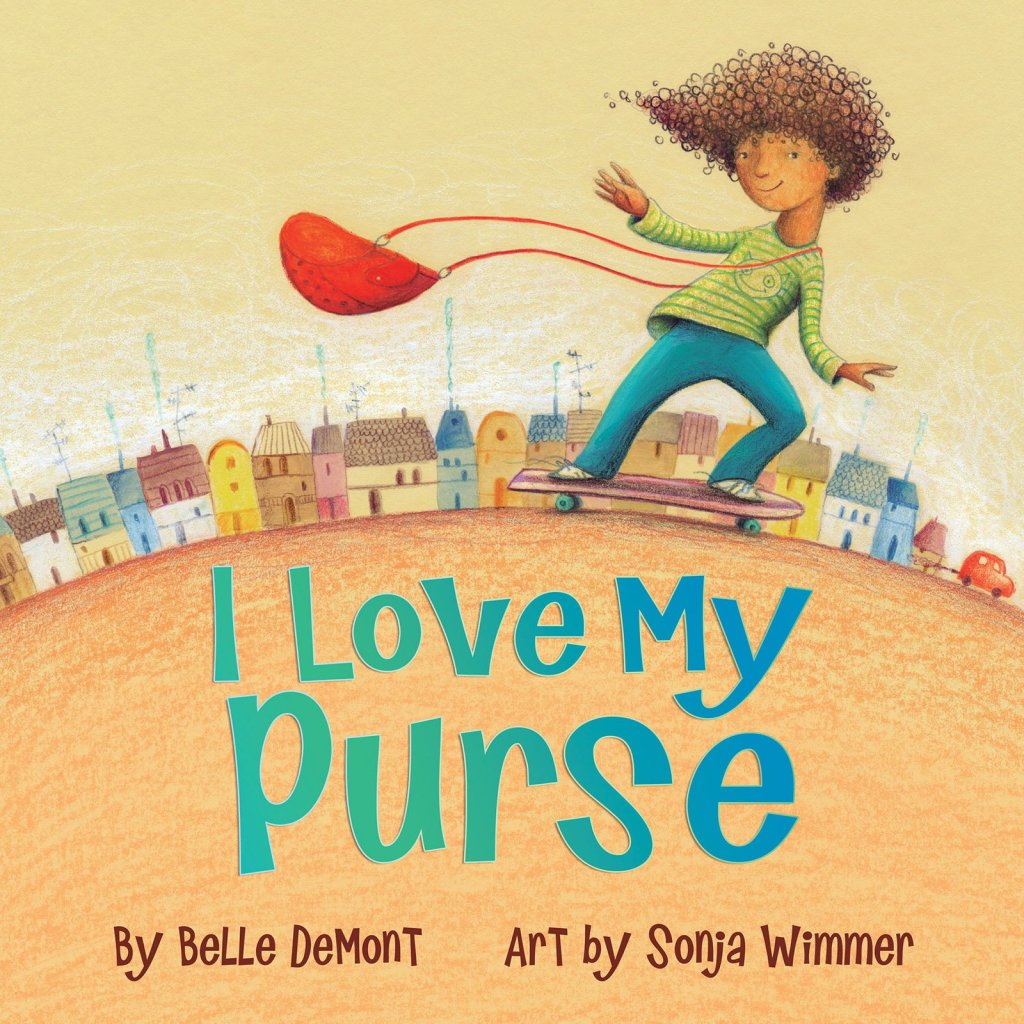
I Love My Purse (2017), written by Belle DeMont and illustrated by Sonja Wimmer, features a boy named Charlie who decides one morning that “enough is enough,” and takes the bright red purse given to him by his grandma out of his closet to wear to school. The picture book highlights the different people Charlie encounters throughout the day, including his dad, who all tell him the same thing: boys don’t wear purses. Charlie always responds with the same statement: “But I love my purse!” As the book goes on, the same people who told Charlie boys don’t wear purses begin to be inspired by Charlie expressing himself how he wants to, regardless of society’s expectations—his dad wears his favorite Hawaiian shirt to work, the girl in his class wears her beloved face paint to school, the boy from the upper grades cooks in the cafeteria, and the crossing guard wears his favorite sparkly shoes! This book does a great job at reminding readers that it is good to be yourself, even if the expression of that goes against what society has normalized.

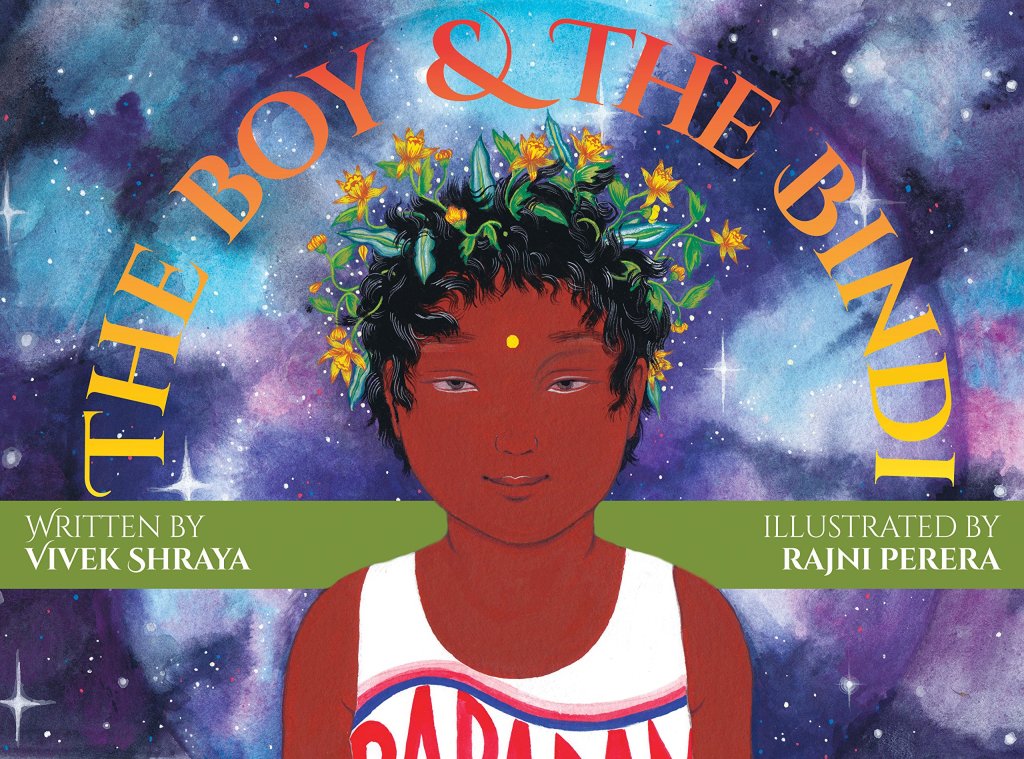
Vivek Shraya’s The Boy & the Bindi (2016), illustrated by Rajni Perera, is about an Indian boy who wishes to wear, like his Ammi, a bindi above his nose. A bindi is a dot, which can come in many colors, and is typically worn by women in Indian culture. The boy’s Ammi says, “My bindi keeps me safe and true” (p. 10). Written in prose and with no specific pronouns to describe the boy, this picture book is purposely left open by Shraya to the boy being a boy who likes “girl things” or a transgender girl. Shraya, who is a transgender woman with Indian heritage, wrote this book after she began wearing a bindi herself and began to get very strange looks from people on the street. Shraya wanted to take the experience and highlight the beauty of bindis for all who wear them. Check out the interview and book reading with Shraya below!

How can I apply lessons from these books to my own classroom?

These books are all so special and important to have highlighted in our classrooms. It is also important for us as educators to learn and understand terms and definitions, to cultivate “gender inclusivity because it provides context and clarity and opens a space in hearts and minds for all genders” (Stachowiak, p. 29). For an updated list of LGBTQ+ definitions, click here to visit the Trans Student Educational Resources (TSER) web page.

While GEORGE ends on a gratifying note, it is left open to the many possibilities of the world: Melissa seems like she is on a path to being her true and happy self, but the cynic in me is also afraid for her. The world is a scary and cruel place many times, unfortunately. I was left wondering about how Melissa’s father, who was mentioned but not featured in the novel, would react to Melissa’s coming out. Would her identity be honored and respected by both her parents? This made me think about an article by Vox that just came out about a court battle over that exact question: “When one parent honors her child’s gender identity and the other does not, what does that mean for the child? More specifically, what will it mean for her socialization, her mental well-being, and who she’s allowed to be?” (2019). The article is an extremely interesting read, and I highly recommend reading it in order to have a better understanding of not only the social ramifications children experience by coming out as transgender but the legal implications as well.

As teachers, we must use quality children’s books in our classrooms that act as “mirrors, windows, and sliding glass doors” (Bishop, 1990) for all our students. This includes our LGBTQIA+ students. They need to have mirror books that reflect their identities, and students who do not identify as queer need to have window books that show them other ways of living in a respectful manner. Not only must we have these books readily available in our classroom libraries but, according to Hermann-Wilmarth and Ryan, we must:

  • Include and contextualize LGBT texts,
  • Read “straight” books through a queer lens, and
  • “Queer,” or bring a queer lens, to LGBT-inclusive texts (2015).

The more we normalize and validate the lives of LGBTQIA+ people in our classrooms, the more accepting a safe a world will be for our students. As Evans, Gilbert, and Doyle say in their article, “Discovering Their Identity” (2017), “Teachers must continually search for, choose to read, and discuss new books with messages that are supportive of all kinds of differences—and hopefully, share those titles with other teachers and parents” (p. 21). These three books are a start to just that.

References
Bishop, R. S. (1990). Mirrors, windows, and sliding glass doors. Perspectives6, ix-xi.
Burns, K. (2019, November 11). What the battle over a 7-year-old trans girl could mean for families nationwide. Retrieved November 11, 2019, from https://www.vox.com/identities/2019/11/11/20955059/luna-younger-transgender-child-custody
Demont, B. (2020). I love my purse. Toronto, Canada: Annick Press.
Evans, S., Gilbert, S., & Doyle, T. (2017). Discovering their identity: Using gender nonconforming picture books in early education classrooms. Literacy Today, 20-21.
Gender Spectrum. (2017, June 7). The boy & the bindi [Video file]. Retrieved from https://youtu.be/UIquybKDbhY
Gino, A. (2015). George. New York, NY: Scholastic Press.
Gino, A. (2019). RICK. Retrieved from http://www.alexgino.com/books/rick/
Hermann-Wilmarth, J. M., & Ryan, C. L. (2015). Doing what you can: Considering ways to address LGBT topics in language arts curricula. Language Arts92(6), 436-442.
Shraya, V. (2016). The boy & the bindi. Vancouver, Canada: Arsenal Pulp Press.
Stachowiak, D. (2018). The power to include: A starting place for creating gender-inclusive literacy classrooms. Literacy Today, 28-30.

Standing Up to Make a Change

“If everyone decided nothing could change, nothing ever would.”

Amal Unbound, Aisha Saeed

In her novel Amal Unbound (2018), Aisha Saeed tells the story of a twelve-year-old Pakistani girl named Amal, who dreams of someday becoming a teacher. Amal loves school, her family, her friends, and reading—then one day, all that she knows is disrupted when she unknowingly upsets the wrong man. After becoming “tired of feeling powerless, … of denying [her] own needs because someone else needed something more” (p. 50), Amal refuses to give this man the last pomegranate from the market; unfortunately for Amal, the man she refused, Jawad Sahib, was the angry son of a powerful landlord in her village, Khan Sahib. Jawad takes his temper out on Amal and her family, demanding that Amal make up for the insult by working as a servant on his estate.

Amal is terrified to leave her friends and family behind, but she believes her father will make enough money soon to pay Jawad Sahib back and return Amal home. At the estate, Amal meets Nasreen Baji, the woman for whom Amal will be the maidservant, and Jawad’s mother. Unlike her cruel son, Nasreen is kind to Amal and asks her about her home village, not far from where Nasreen herself grew up. Also on the estate, Amal gets to know the other people that work for the Khan family—some willing workers and some indentured servants—including a girl about the same age named Nabila, a teenager named Bilal, and a young girl about nine-years-old named Fatima. Although at first Nabila and Amal do not get along, it ends up being these friends—and a love of reading—that help get Amal through the most trying time in her life.

Although Nasreen is kind and Amal makes friends, she longs to be relieved of her debt to Jawad and home with her family again. The longer Amal works at the estate, the more hopeless she feels that this will ever happen—and the more Amal becomes aware of how dangerous Jawad really is. Amal realizes that if she wants anything to change for her or others indebted to the Khan family, she must stand up and create the change herself. This book asks students to struggle with many justices and injustices, including: indentured servitude, economic class, family, resistance, and freedom. One of my favorite parts of the book is at the very end, in the Author’s Note (p. 231):

There are brave girls all over the world. They may feel afraid
sometimes, like Amal. But doing the right thing despite the
risks it may involve is the bravest thing there can be. It is my
hope this story shines a light on brave girls everywhere.

Malala, a Brave Girl from Pakistan/Iqbal, a Brave Boy from Pakistan: Two Stories of Bravery (2014) by Jeanette Winter is a beautiful and inspiring double-sided book that features the stories of Malala Yousafzai and Iqbal Masih, two Pakistani children who were “Each unafraid to speak out. Each a victim of unspeakable violence. Each an inspiration to the world” (book jacket). In Malala’s side, readers learn about the brave girl who spoke out about girls’ right to education, causing her to be shot by the Taliban at just 15 years old. The shot went through her head and neck and into her shoulder, and after receiving life-saving surgery and care from doctors in England, Malala survived the attack on her life, and continued to stand up and speak out for girls’ education everywhere.

The real Malala Yousafzai and Iqbal Masih

Not as fortunate as Malala but just as inspiring, Iqbal’s side of this tête-bêche (head-to-tail) book leads readers to explore how a brave boy was freed from Peshgi, the loans that held children in bondage in Pakistan. Once he was liberated at ten-years-old, Iqbal began school and spoke out for children like him, still in bondage. Unlike in Malala’s story, however, Iqbal does not survive the threats on his life by the factory owners he spoke out against: on April 16, 1995, Iqbal was shot and killed for standing up for what was right.

Throughout the book, kites are used to symbolize the freedom that both Iqbal and Malala dream of. In the center of the book, where the two stories meet, Winter has illustrated a double-spread on which we see Malala and Iqbal looking at each other from opposite sides, upside-down to one another. In contrast to Malala and the rest of the spread, which are in full and bright color, Iqbal is illustrated as completely gray. Each one has a kite: Malala still holding hers, Iqbal having let go of his. Iqbal’s coloring and his kite flying away symbolize the loss of his life that tragic day. Perhaps, though, he has not simply lost his kite, but has maybe let go to pass it on for another person to take hold of as they stand up for peoples’ freedom.

I would be remiss if I did not discuss the authors of these two books as I critically engage with them. As a Pakistani-American author, Saeed (below) is able to capture an #OwnVoices narrative about the culture of her family and ancestors as she wrote Amal Unbound.

Aisha Saeed

Jeanette Winter (below), on the other hand, does not have the experience of being Pakistani as she wrote and illustrated Malala/Iqbal. I feel this is important to point out, because although I believe Winter did a great job researching Malala and Iqbal for the book, there are a few things I noticed as I critically analyzed its illustrations that may be in part due to Winter being White. One thing I noticed, for example, was on the page that depicts the 800 mourners at Iqbal’s funeral, the mourners are presented wearing all-black attire—when in reality, often Pakistanis wear white to a funeral. The other, larger misrepresentation I noticed as I looked at the illustrations in Winter’s book was the color of the Pakistanis’ skin throughout the book. Both children (and characters in the background) are depicted as having fairly light in the book’s illustrations; in reality, both children had more brown skin, particularly Iqbal. I am sure that this slight white-washing was unintentional on Ms. Winter’s part; however, it is important that readers are able to notice things like this as they critically engage themselves in books, particularly books about people of color.

Jeanette Winter

Both Amal Unbound and Malala/Iqbal examine children who discover their agency and use it to make a change in the world. Books like these are so vital for students to read, because as Laminack and Kelly discuss in chapter 5 of their book Reading to Make a Difference (2019), “children believe they can make a difference in this big wide world. And we believe in children” (p. 84). These two books serve as perfect models for students of children who made a change, showing them that kids do have power and that they are capable of creating change as well. We want our children to feel empowered by the books we provide in our class libraries; both of these books do exactly that.

How can I apply lessons from these books to my own classroom?

I think every classroom should have copies of these books in their library—featuring everyday children who make choices “even when they scare [them] because [they] know it’s the right thing to do” (Saeed, p. 210). Amal Unbound and Malala/Iqbal are perfect books to help students “consider issues of inequality and ways to advocate for change by taking a stand on an issue they feel is important” (Laminack & Kelly, p. 88). This is especially important for understanding historical events, as oftentimes students feel stories like Iqbal’s are “history that happened long ago” (Laminack & Kelly, p. 88); students must be able to ask, “how does this affect me or others today?” and “why is this important?” These books could be supplemented by photographs, primary documents, articles or newspaper clippings, online resources, video clips, artifacts, guest speakers, and more to help them examine the significance they hold for us.

Additional resources about activism that students can read to supplement their reading of Amal Unbound and Malala/Iqbal may include:

Looking at these books and supplemental resources, students can trace themes within and across sources to ultimately come to some conclusions about social justice using the following questions as a guide (Laminack & Kelly, p. 92):

  • Why do we treat people differently?
  • How do people respond to difficult topics?
  • Ho do I view the world?
  • What can I do myself to promote all people in my individual world?

When students read about how Malala spoke out for her right to an education despite threats from the Taliban; how Iqbal stood up to help free children from bondage across Pakistan; how Amal set about to gain freedom for herself and others from a grossly powerful man; students will begin to have meaningful conversations about the issues in their world and how to take action (Laminack & Kelly, p. 92). And isn’t that exactly what we want from our students? For them to “be the change that [they] wish to see in the world.”

References
Laminack, L. L., & Kelly, K. (2019). Advocating for Change. In Reading to make a difference: Using literature to help students speak freely, think deeply, and take action (pp. 83-97). Portsmouth, NH: Heinemann Educational Books.
Saeed, A. (2018). Amal unbound. New York, NY: Nancy Paulsen Books.
Winter, J. (2014). Malala, a brave girl from Pakistan/Iqbal, a brave boy from Pakistan: Two stories of bravery. New York, NY: Beach Lane Books.
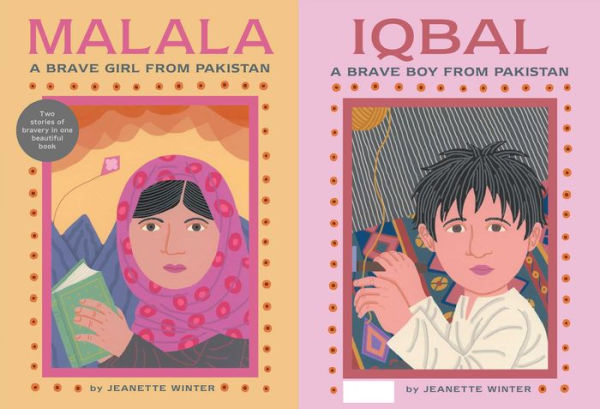
Design a site like this with WordPress.com
Get started