“If everyone decided nothing could change, nothing ever would.”
–Amal Unbound, Aisha Saeed
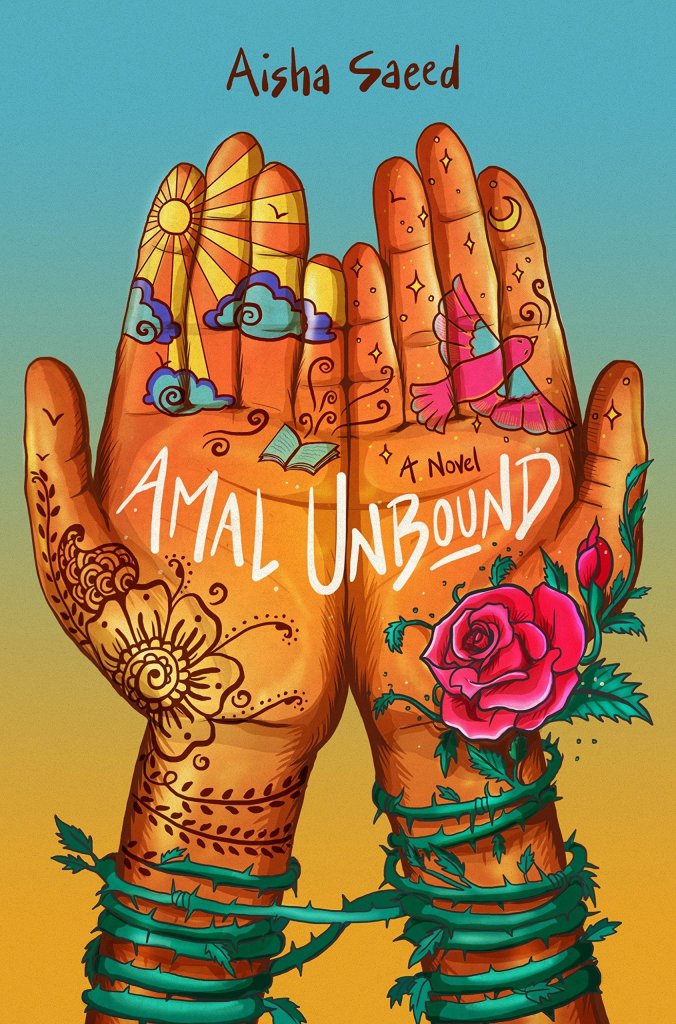
In her novel Amal Unbound (2018), Aisha Saeed tells the story of a twelve-year-old Pakistani girl named Amal, who dreams of someday becoming a teacher. Amal loves school, her family, her friends, and reading—then one day, all that she knows is disrupted when she unknowingly upsets the wrong man. After becoming “tired of feeling powerless, … of denying [her] own needs because someone else needed something more” (p. 50), Amal refuses to give this man the last pomegranate from the market; unfortunately for Amal, the man she refused, Jawad Sahib, was the angry son of a powerful landlord in her village, Khan Sahib. Jawad takes his temper out on Amal and her family, demanding that Amal make up for the insult by working as a servant on his estate.
Amal is terrified to leave her friends and family behind, but she believes her father will make enough money soon to pay Jawad Sahib back and return Amal home. At the estate, Amal meets Nasreen Baji, the woman for whom Amal will be the maidservant, and Jawad’s mother. Unlike her cruel son, Nasreen is kind to Amal and asks her about her home village, not far from where Nasreen herself grew up. Also on the estate, Amal gets to know the other people that work for the Khan family—some willing workers and some indentured servants—including a girl about the same age named Nabila, a teenager named Bilal, and a young girl about nine-years-old named Fatima. Although at first Nabila and Amal do not get along, it ends up being these friends—and a love of reading—that help get Amal through the most trying time in her life.
Although Nasreen is kind and Amal makes friends, she longs to be relieved of her debt to Jawad and home with her family again. The longer Amal works at the estate, the more hopeless she feels that this will ever happen—and the more Amal becomes aware of how dangerous Jawad really is. Amal realizes that if she wants anything to change for her or others indebted to the Khan family, she must stand up and create the change herself. This book asks students to struggle with many justices and injustices, including: indentured servitude, economic class, family, resistance, and freedom. One of my favorite parts of the book is at the very end, in the Author’s Note (p. 231):
There are brave girls all over the world. They may feel afraid
sometimes, like Amal. But doing the right thing despite the
risks it may involve is the bravest thing there can be. It is my
hope this story shines a light on brave girls everywhere.
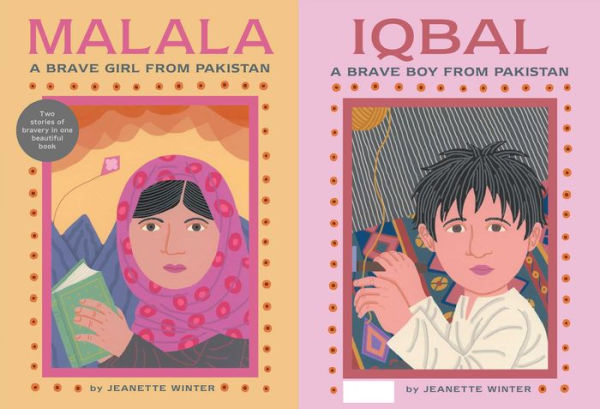
Malala, a Brave Girl from Pakistan/Iqbal, a Brave Boy from Pakistan: Two Stories of Bravery (2014) by Jeanette Winter is a beautiful and inspiring double-sided book that features the stories of Malala Yousafzai and Iqbal Masih, two Pakistani children who were “Each unafraid to speak out. Each a victim of unspeakable violence. Each an inspiration to the world” (book jacket). In Malala’s side, readers learn about the brave girl who spoke out about girls’ right to education, causing her to be shot by the Taliban at just 15 years old. The shot went through her head and neck and into her shoulder, and after receiving life-saving surgery and care from doctors in England, Malala survived the attack on her life, and continued to stand up and speak out for girls’ education everywhere.
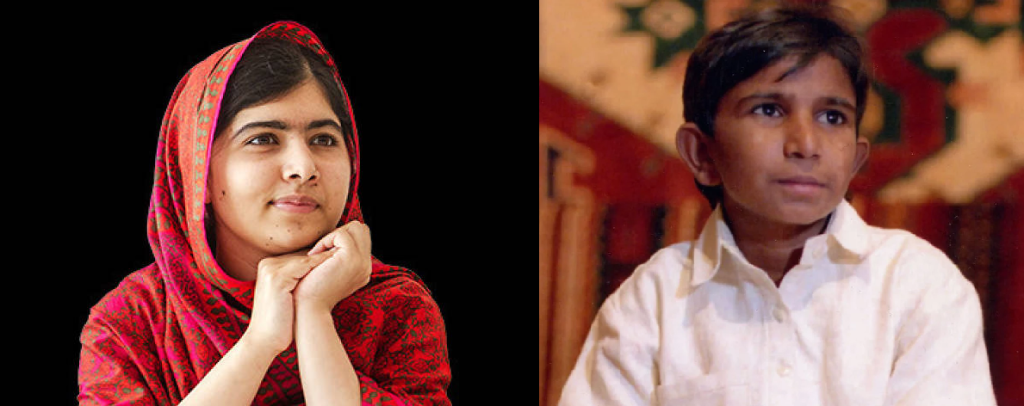
Not as fortunate as Malala but just as inspiring, Iqbal’s side of this tête-bêche (head-to-tail) book leads readers to explore how a brave boy was freed from Peshgi, the loans that held children in bondage in Pakistan. Once he was liberated at ten-years-old, Iqbal began school and spoke out for children like him, still in bondage. Unlike in Malala’s story, however, Iqbal does not survive the threats on his life by the factory owners he spoke out against: on April 16, 1995, Iqbal was shot and killed for standing up for what was right.
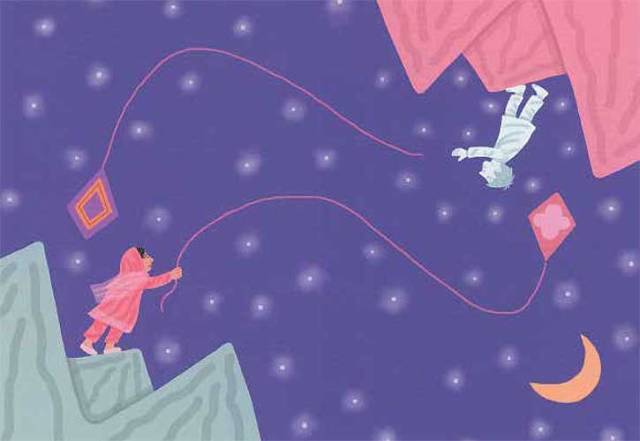
Throughout the book, kites are used to symbolize the freedom that both Iqbal and Malala dream of. In the center of the book, where the two stories meet, Winter has illustrated a double-spread on which we see Malala and Iqbal looking at each other from opposite sides, upside-down to one another. In contrast to Malala and the rest of the spread, which are in full and bright color, Iqbal is illustrated as completely gray. Each one has a kite: Malala still holding hers, Iqbal having let go of his. Iqbal’s coloring and his kite flying away symbolize the loss of his life that tragic day. Perhaps, though, he has not simply lost his kite, but has maybe let go to pass it on for another person to take hold of as they stand up for peoples’ freedom.
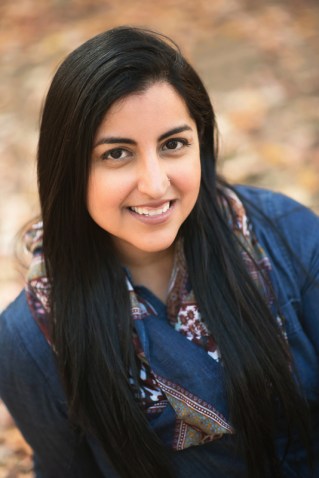
I would be remiss if I did not discuss the authors of these two books as I critically engage with them. As a Pakistani-American author, Saeed (below) is able to capture an #OwnVoices narrative about the culture of her family and ancestors as she wrote Amal Unbound.
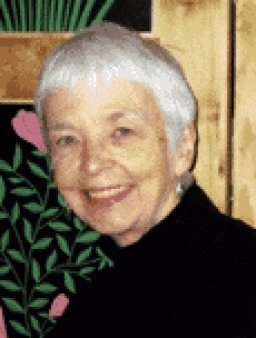
Jeanette Winter (below), on the other hand, does not have the experience of being Pakistani as she wrote and illustrated Malala/Iqbal. I feel this is important to point out, because although I believe Winter did a great job researching Malala and Iqbal for the book, there are a few things I noticed as I critically analyzed its illustrations that may be in part due to Winter being White. One thing I noticed, for example, was on the page that depicts the 800 mourners at Iqbal’s funeral, the mourners are presented wearing all-black attire—when in reality, often Pakistanis wear white to a funeral. The other, larger misrepresentation I noticed as I looked at the illustrations in Winter’s book was the color of the Pakistanis’ skin throughout the book. Both children (and characters in the background) are depicted as having fairly light in the book’s illustrations; in reality, both children had more brown skin, particularly Iqbal. I am sure that this slight white-washing was unintentional on Ms. Winter’s part; however, it is important that readers are able to notice things like this as they critically engage themselves in books, particularly books about people of color.
Both Amal Unbound and Malala/Iqbal examine children who discover their agency and use it to make a change in the world. Books like these are so vital for students to read, because as Laminack and Kelly discuss in chapter 5 of their book Reading to Make a Difference (2019), “children believe they can make a difference in this big wide world. And we believe in children” (p. 84). These two books serve as perfect models for students of children who made a change, showing them that kids do have power and that they are capable of creating change as well. We want our children to feel empowered by the books we provide in our class libraries; both of these books do exactly that.
How can I apply lessons from these books to my own classroom?
I think every classroom should have copies of these books in their library—featuring everyday children who make choices “even when they scare [them] because [they] know it’s the right thing to do” (Saeed, p. 210). Amal Unbound and Malala/Iqbal are perfect books to help students “consider issues of inequality and ways to advocate for change by taking a stand on an issue they feel is important” (Laminack & Kelly, p. 88). This is especially important for understanding historical events, as oftentimes students feel stories like Iqbal’s are “history that happened long ago” (Laminack & Kelly, p. 88); students must be able to ask, “how does this affect me or others today?” and “why is this important?” These books could be supplemented by photographs, primary documents, articles or newspaper clippings, online resources, video clips, artifacts, guest speakers, and more to help them examine the significance they hold for us.
Additional resources about activism that students can read to supplement their reading of Amal Unbound and Malala/Iqbal may include:
- How to Introduce Children to Activism
- 20 Young Activists Who are Changing the World
- DoSomething.org
- Using Their Words
- Learning to Give
- Teachers’ Guide to Global Collaboration
- 15 Children’s Books Set in Pakistan (create a text set!)
Looking at these books and supplemental resources, students can trace themes within and across sources to ultimately come to some conclusions about social justice using the following questions as a guide (Laminack & Kelly, p. 92):
- Why do we treat people differently?
- How do people respond to difficult topics?
- Ho do I view the world?
- What can I do myself to promote all people in my individual world?
When students read about how Malala spoke out for her right to an education despite threats from the Taliban; how Iqbal stood up to help free children from bondage across Pakistan; how Amal set about to gain freedom for herself and others from a grossly powerful man; students will begin to have meaningful conversations about the issues in their world and how to take action (Laminack & Kelly, p. 92). And isn’t that exactly what we want from our students? For them to “be the change that [they] wish to see in the world.”
References
Laminack, L. L., & Kelly, K. (2019). Advocating for Change. In Reading to make a difference: Using literature to help students speak freely, think deeply, and take action (pp. 83-97). Portsmouth, NH: Heinemann Educational Books.
Saeed, A. (2018). Amal unbound. New York, NY: Nancy Paulsen Books.
Winter, J. (2014). Malala, a brave girl from Pakistan/Iqbal, a brave boy from Pakistan: Two stories of bravery. New York, NY: Beach Lane Books.
 Ms. Schmidt's Reading Blog