“Just because you don’t see the path doesn’t mean it’s not there.”
–The Parker Inheritance, Varian Johnson
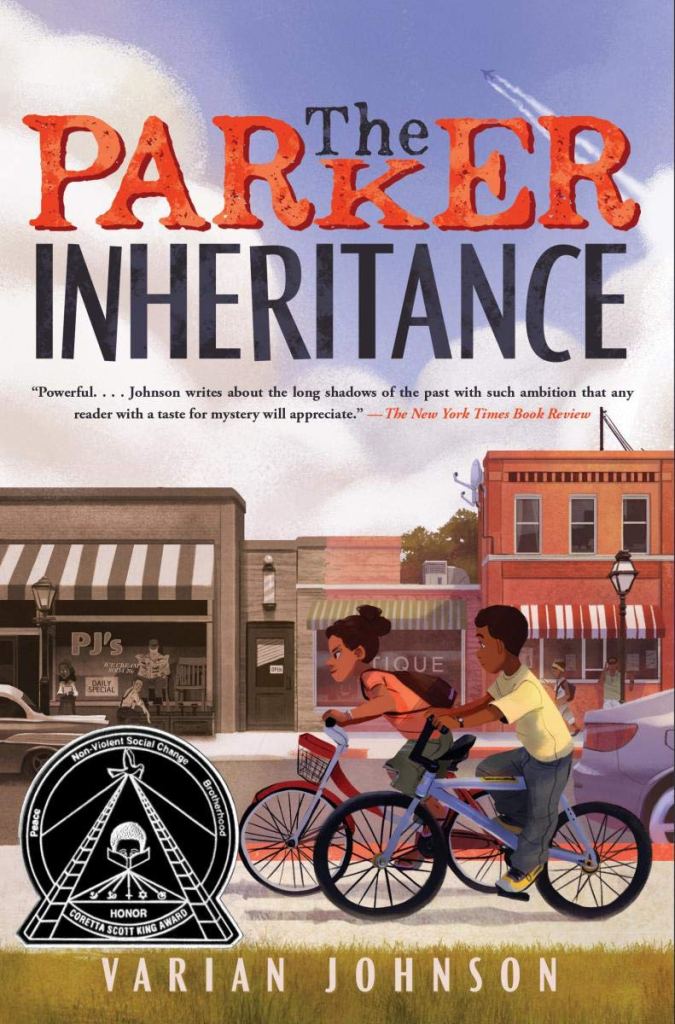
Holy cow, this book! Written in 2017 by Varian Johnson, The Parker Inheritance is the mystery novel every aspiring detective needs. When Candice Miller moves to Lambert, South Carolina for the summer, all she expects is a boring summer away from her friends in Atlanta and rereading the same books from the library over and over. But when Candice finds a letter addressed to her grandmother Abigail Caldwell, with her grandmother’s own handwriting on the envelope—Find the path. Solve the puzzle.—she finds an unsolved mystery from a decade ago, waiting to be solved. But she can’t do it alone. To solve the mystery and find the inheritance it promises, Candice needs help from her new friend from across the street, Brandon Jones. What they then find together is a greater passion for books, Lambert’s ugly past, and a friendship unlike any other.

Varian Johnson wrote The Parker Inheritance, which was named a 2019 Coretta Scott King Honor Book and a 2018 Boston Globe-Horn Honor Book, in part based on his own childhood growing up. Johnson grew up a Black kid in South Carolina, in a little town called Florence (which inspired the town of Lambert in the novel). Many important aspects of the book are also based on places or events from his childhood, including Perkins High School (based on Wilson High School in Florence, SC), the Perkins-Wallace Tennis Exhibition (inspired by a secret basketball game in 1944 between the North Carolina College for Negroes and the Duke University medical school team, in which the NCCN won by a score of 88-44), Briggs v. Elliot, and more.
How can I apply lessons from these books to my own classroom?
A page on Johnson’s author website also gives readers a look into the story behind The Parker Inheritance. An interaction Johnson and his twin brother had with a police officer in their junior year of high school drove Johnson to write about race relations and the unfair discrimination and hurt that comes with being born Black.
This book addresses many social justice issues throughout its pages, including that of race and discrimination discussed above. These issues are as, if not more, integral to the story in The Parker Inheritance. The novel is written in three different main timelines: Abigail Caldwell’s time attempting to solve the puzzle around 2007, Candice and Brandon’s attempt in 2017, and a time going from around 1914 until about 1986 that details the events that led to the letter being written. It is this latter timeline that helps readers learn more about Jim Crow laws, segregation (“separate but equal”), and deep injustices especially frequent in the deep South during the time. It would be a good idea to discuss with students prior to reading about these social issues, as well as the horrific cruelty that was lynching (Johnson, p.116), and deep-rooted discrimination that Black people in the US have faced since the end of slavery (“I don’t care how many courses you take or how many books you read. You’ll [as a White man] never understand what it means to be a Negro. You’ll never face the discrimination they see every day. You’ll never struggle the way they do,” Johnson, p. 170).
In Candice and Brandon’s modern-day timeline, the continuance of racist systemic social injustices is displayed for readers: the occurrence of segregation remaining in schools and neighborhoods despite Brown v. Board of Education ruling it was unconstitutional, the implicit assumptions that Black people are up to something because they “looked suspicious” (Johnson, p. 131-132). This racial profiling is unfortunately all too-familiar for Johnson himself, whose experience with the police officer at the airport (linked above) was based solely on his and his brother’s skin color. Also in this timeline, the fear that Black people have of their cars being pulled over by cops and the fear of being shot (despite being unarmed) is highlighted every time Brandon’s sister Tori drives the duo somewhere.
Even further, The Parker Inheritance steps away from just racial injustice, but also the rights and protections needed for people ho identify as LGBTQIA+. Candice wonders throughout the book if Brandon is gay (which is never answered), and at the end of the book she actually stands up to Brandon’s grandfather for his outdated beliefs and prejudices (“He is perfect just the way he is. … He. Is. Perfect,” Johnson, p. 311-312). Other characters featured in the novel are also gay, including Brandon’s best friend who is away for the summer and Candice’s father. This opens up discussion with students on the topic of loving and accepting LGBTQIA+ people for who they are.
There are just so many different directions and social justice topics you could hit with your students through this book. It is important to keep in mind that you should not use this single text to discuss these topics with students. There should be a vast array of other culturally diverse books and stories in your classroom that reflect your students’ lives, including many featuring Black lives (Boyd, Causey, & Galda, 2014). When you think about your classroom library, pause and ponder (Boyd, Causey, & Galda, 2014):
- When I select literature, what criteria am I using? How am I including culturally diverse literature in my classroom?
- What do I need to know and learn about all of my students in order to select and evaluate relevant and appropriate high-quality, culturally diverse literature?
- What informed decisions about culturally diverse literature do I need to make in order to help my students meet the Common Core State Standards for reading literature?
Be sure also to think about the four ways of connecting texts through different points of consideration (Ciecierski, 2017): companion texts, corresponding texts, contradictory texts, and cluster texts.
The Parker Inheritance is probably one of the best children’s books I’ve read—fun, mysterious, and full of good social justice discussions—and I highly recommend it to anyone for their classroom library.
 References
Boyd, F. B., Causey, L. L., & Galda, L. (2014). Culturally diverse literature: Enriching variety in an era of common core state standards. The Reading Teacher, 68(5), 378-387. doi:10.1002/trtr.1326
Ciecierski, L. M. (2017). What the common core state standards do not tell you about connecting texts. The Reading Teacher, 71(3), 285-294. doi:10.1002/trtr.1616
Johnson, V. (2018). The Parker inheritance. Broadway, NY: Scholastic Inc.
Varian Johnson. (2017, May 31). The story behind the Parker inheritance. Retrieved from http://varianjohnson.com/books/the-parker-inheritance/story-behind-parker-inheritance/
 Ms. Schmidt's Reading Blog