“This piece of earth was a world apart.
Congo Square was freedom’s heart.”
-Freedom in Congo Square, Carole Boston Weatherford & R. Gregory Christie
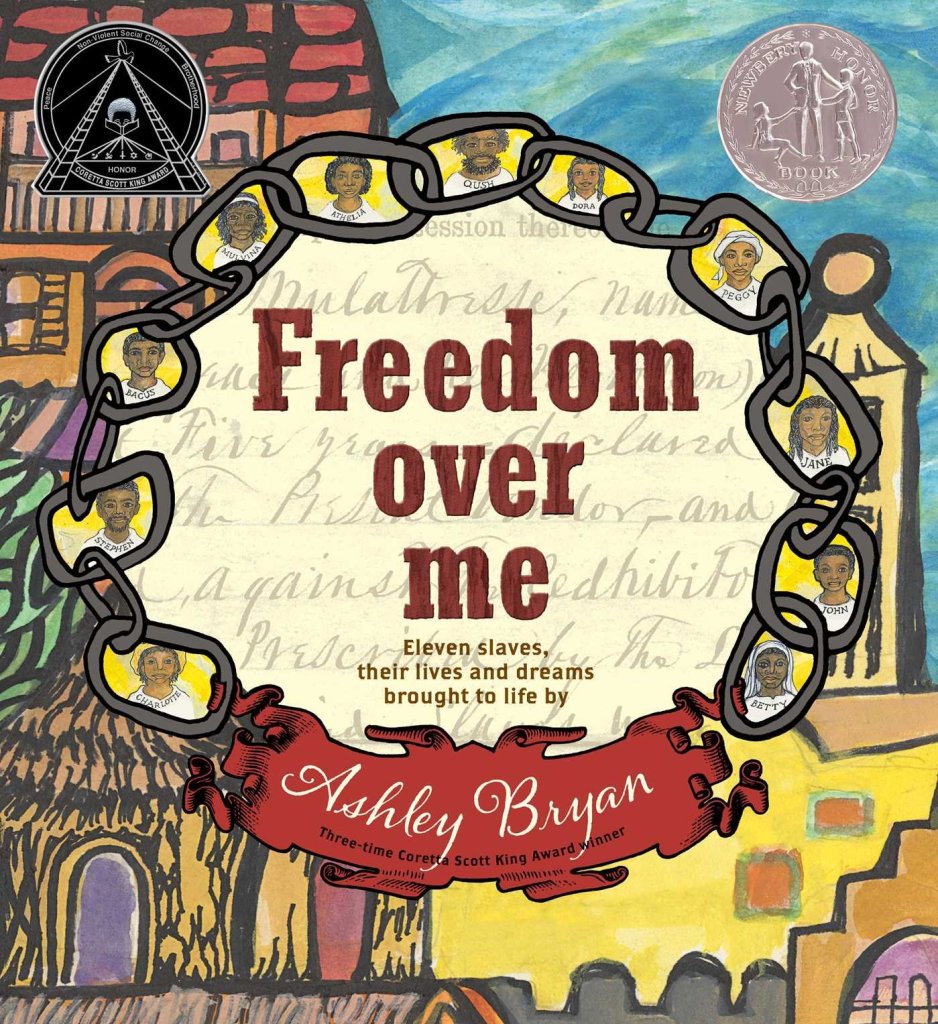
Freedom over me: Eleven slaves, their lives and dreams brought to life (2016), written and illustrated by three-time Coretta Scott King Award winner Ashley Bryan, brings eleven real slaves from the estate of a white woman in 1828 to life, along with the dreams of freedom they may have had. Working from a primary source document—an appraisement estate document for a Mrs. Fairchilds—Bryan uses the sparing information about these slaves (only their names and the price they were being sold for) to imagine their backgrounds, thoughts, and dreams and bring them to life as not just property to be sold, but as human beings.
Each slave is given two spreads in the book: one that describes their “reality” (though made up by Bryan) and one that details the “dreams” they have. For example, one of the slaves from the appraisement, Jane (age 28, $300) was imagined by Bryan on the “reality” spread (p. 13-14) to have been the seamstress to Mrs. Fairchilds with beautiful skill with cloth. On the next page (p. 15-16), “Jane dreams” about her African name given to her by her parents, Serwaa, meaning “jewel”; she dreams about the salvation that weaving provides her, offering tribute to her ancestors of all praise for her work she receives; she dreams about marriage to Stephen, one of the other slaves on the estate.
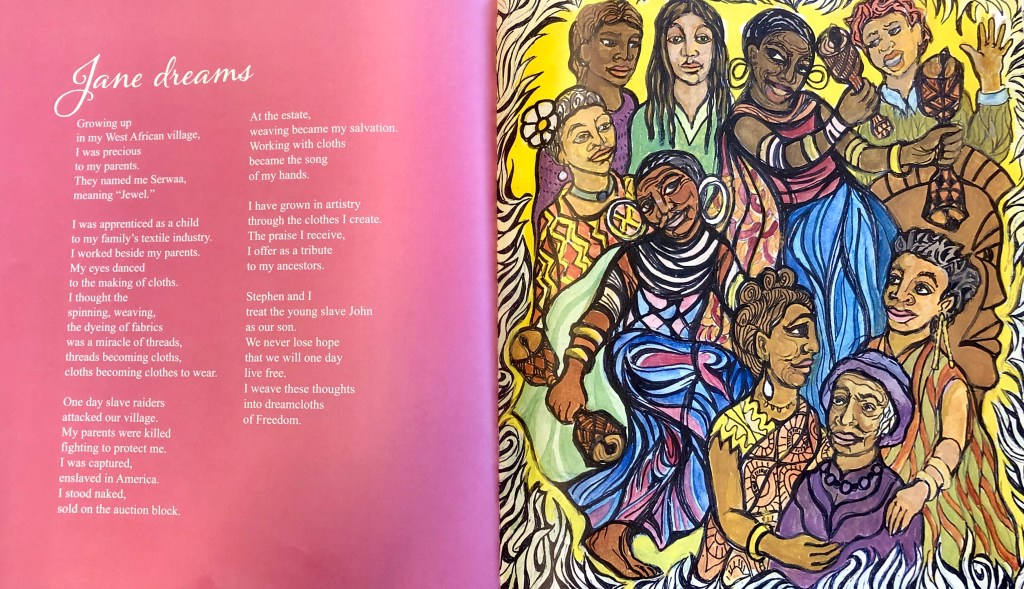
The illustrations on each page are absolutely beautiful and give life to each person listed on the appraisement. Rendered in pen, ink, and watercolor, as well as collaged photo-reproductions of historical deeds, Byran’s the “reality” spread for each slave features a detailed illustration of the person laid over top of collaged documents with words such as “slave,” “offered for sale,” “to be sold,” or “Negroes”. The contrasting “dreams” spreads feature the same slave on the “reality” spread but in their happy place, their sanctuary, their salvation.
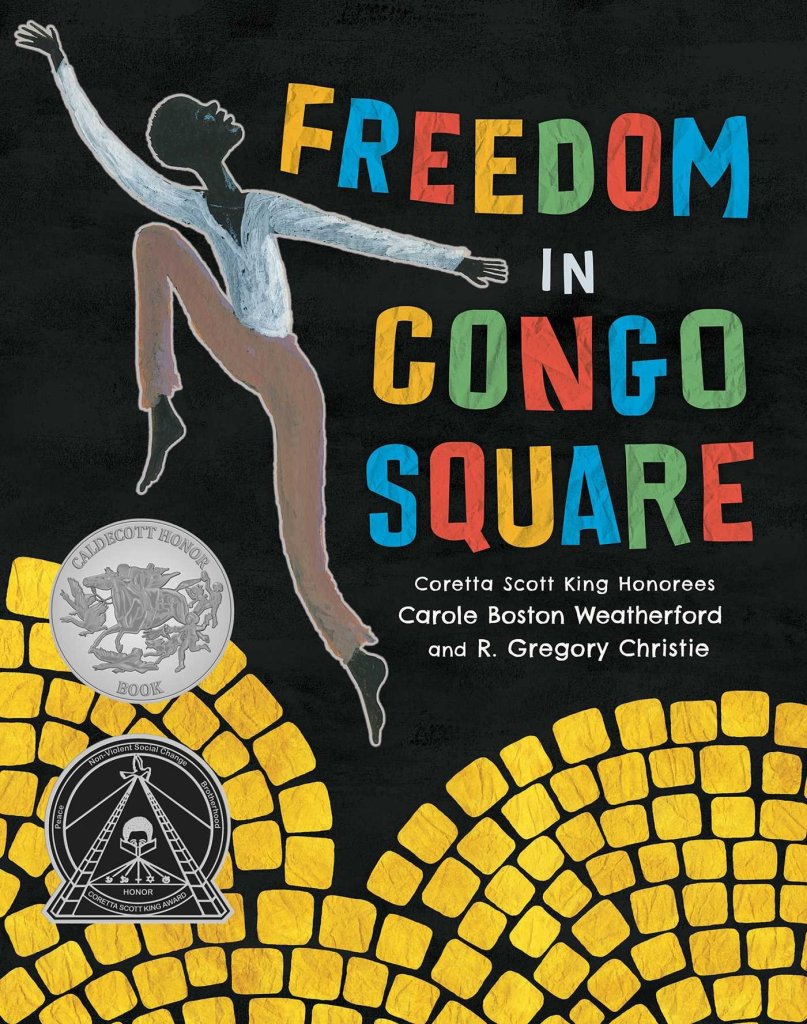
Freedom in Congo Square, by Carole Boston Weatherford and R. Gregory Christie (2016) uses a rhythmic prose to count down the days of the week until Sunday, when slaves were allowed to take off work, thanks to what was called the Code Noir (which made Sundays a holy day), and go to Congo Square. It briefly details the hard work and suffering that slaves had to deal with as they got through the week, as “a moment without work was rare” (p. 6). This book is based on the real-life Congo Square in New Orleans, Louisiana, where hundreds of slaves and free Blacks celebrated their African heritage and culture with traditional African music and dances, practiced African religious beliefs, spoke African languages, communicated concerns with others, and sold various items as vendors.
Still today, Congo Square celebrates African culture every Sunday with music and dancing. It is now a part of the Louis Armstrong Park and continues to sustain life and customs for many people there.
How can I apply lessons from these books to my own classroom?
These two books would fit perfectly in a curriculum unit about the effects of slavery, specifically to highlight the humanity slaves had—to think on their own, to survive, to dream. Freedom over me especially gives students the ability to look through a window into the life of a slave, and what that might have been like; it provides them with a new perspective, one that is almost never portrayed in literature unfortunately, one that shows slaves as having lives as human beings. Students should be encouraged to then open and step through the sliding glass door that opens them up to empathy.
This could be taken a step further by teaching students about persona poetry and “I am” poems. Taking it back to one of the books from my last blog post, A Crack in the Sea by H.M. Bouwman could also be brought in for discussion on this slavery and freedom unit, as it puts a fictional spin on the real-life Zong slave ship that killed approximately 133 slaves by throwing them overboard. Below, read my example of an “I am” poem about Venus, one of the most pivotal characters in the book.
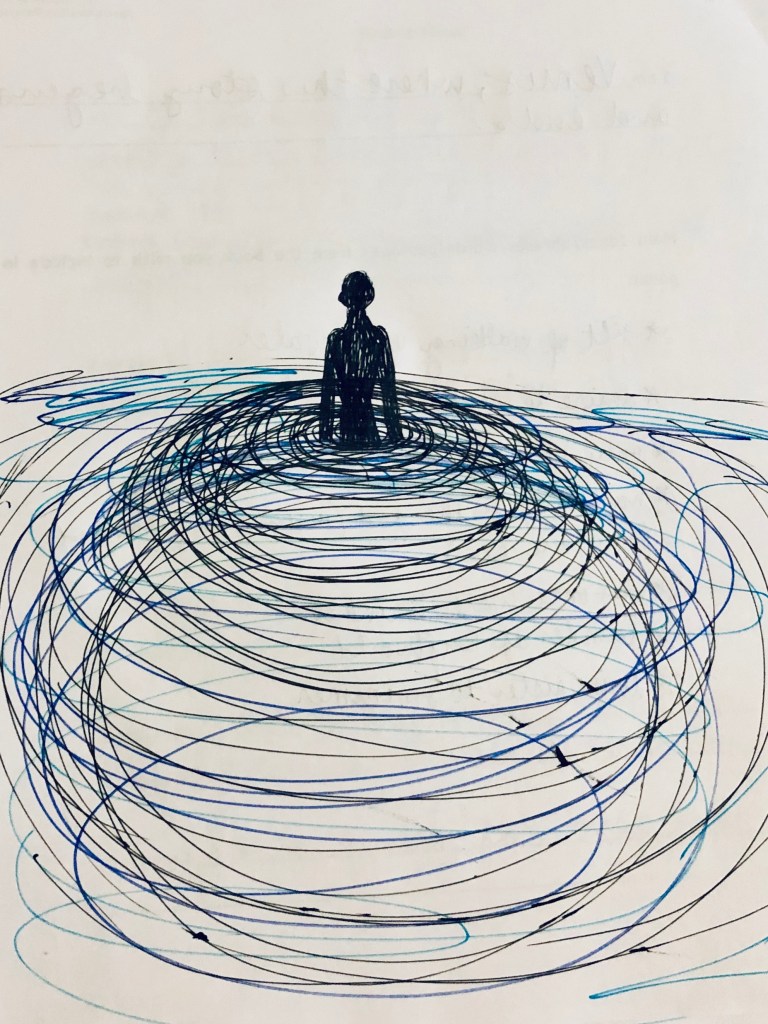
I am Venus
by Grace Schmidt

I am Venus, once named Water Drinker, but took the name of the
god who rose from the sea fully formed.
I live in the second world, though I haven't always.
I wonder what the first world is like now—does it still enslave my
people?

I am the twin sister of Swimmer.
I hear my brother say, "keep your memories pushed down."
I dream of my parents, who were taken from me when the
slavers came.
I try to be strong.
I want to find my home.
I hope that I will, someday.

I am the founder of Raftworld.
I see the kraken, still looking for his wife—his home.
I question whether my people should return to Africa.
I feel it is too dangerous—we should remain in the second world
where it's safe.
I'm as strong as the god I am named for, but
I worry I did not lead my people the best way I could have.

I taste the sweet water of the second world and know I belong
here.
I say, "I trade myself willingly. I say goodbye to my beloved old
home, which I will never forget, and open my heart to my new."
I excel at walking underwater—the ocean feels like home.

I understand it is my time to go. I walk back to the ocean and
return home.
I believe everything will turn out all right in the end.
I was once taken as a slave, bound for the Caribbean to be sold as
property.
But now I am a leader for my people.
I am Venus, where this story begins and ends.
Students should be asked to compare the two spreads (“reality” and “dreams”) in Freedom over me given to each slave described, and explain how each contrasts to give different perspectives of who they might have been. Then, encourage students to write their own persona poetry to expand upon what Bryan has dreamed up for one of the slaves of their choice.
I highly recommend both Freedom over me and Freedom in Congo Square as wonderful additions to any classroom library.
References
Bouwman, H. M. (2017). A crack in the sea. New York, NY: Puffin Books.
Bryan, A. (2016). Freedom over me: Eleven slaves, their lives and dreams brought to life. New York, NY: Antheneum Books for Young Readers.
Frye, E. M., Hardin, B. L., Bouwman, H. M., & Stumb, A. E. (2018). Walking into the wardrobe and through the sliding glass door: Writing persona poems with A Crack in the Sea. Voices from the Middle, 26(2), 46-52.
Weatherford, C. B., & Christie, R. G. (2016). Freedom in Congo Square. New York, NY: Simon & Schuster.
 Ms. Schmidt's Reading Blog