“Sometimes when you’re surrounded by dirt, CJ, you’re a better witness for what’s beautiful.”
–Last Stop on Market Street, Matt de la Peña
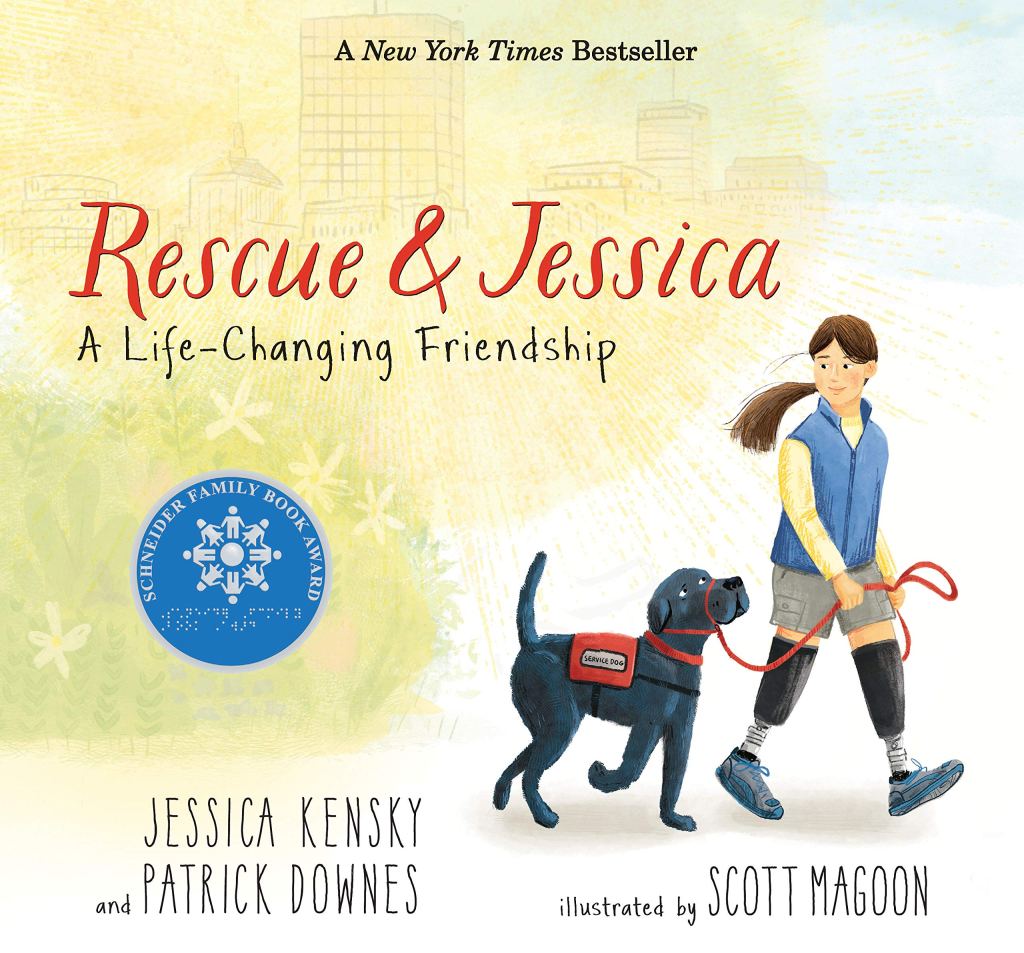
Rescue & Jessica: A Life-Changing Friendship is based on the true story of how Jessica met her service dog, Rescue, after she lost both her legs in the aftermath of the 2013 Boston Marathon bombing. Written in 2018 by the real-life titular character, Jessica Kensky, and her husband Patrick Downes, Rescue & Jessica won the 2019 Schneider Family Book Award for its excellence of portrayal of the disability experience in literature for youth. The picture book was also illustrated by another of the bombing survivors, Scott Magoon. This story is one of overcoming the odds and how disability can bring a positive light to one’s life.
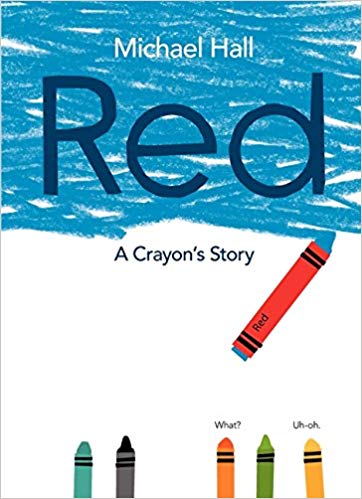
Michael Hall’s Red: A Crayon’s Story tells the tale of a young crayon, Red, who just cannot seem to do what he’s supposed to: color red. Everything he draws ends up blue! Written and illustrated by Hall in 2015, Red‘s hero has a factory-made label that makes everyone in his life (including Red) think that he just can’t draw anything right. That is, until a new friend asks Red to color something for them, and Red finds his true strength of coloring all things blue.
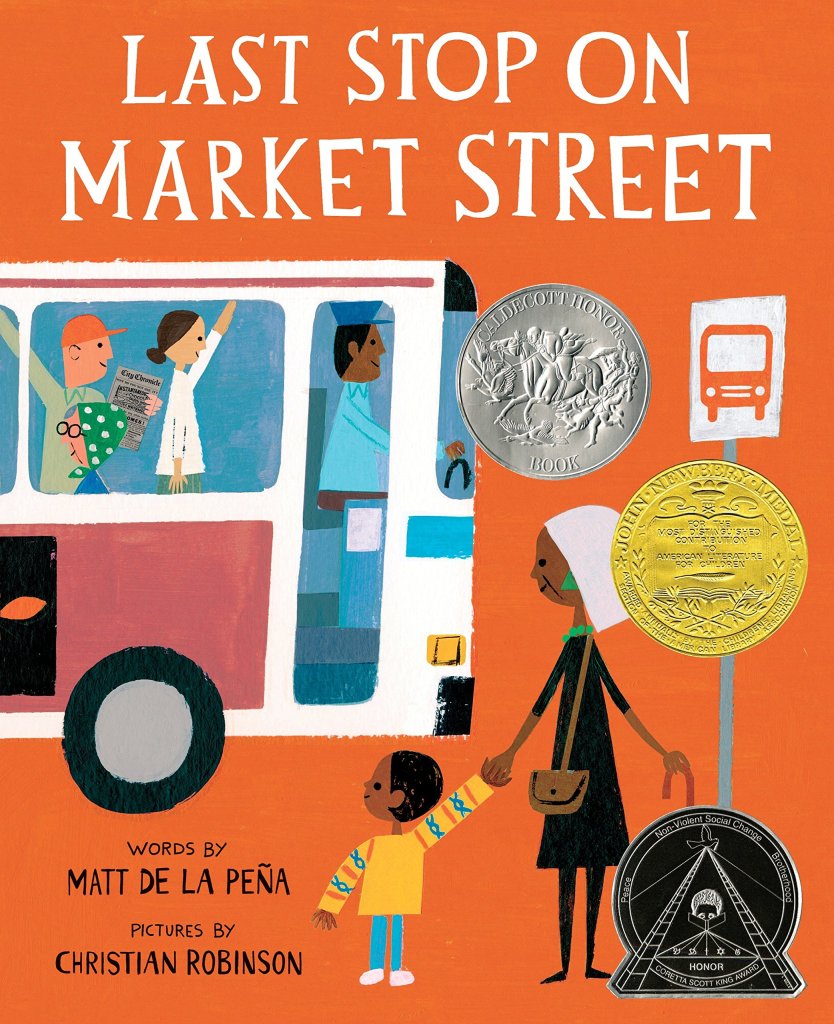
The picture book Last Stop on Market Street was written in 2015 by Matt de la Peña and illustrated by Christian Robinson. In 2016, it was awarded the John Newbery Medal, as well as the Coretta Scott King Illustrator Honor Award and the Caldecott Honor Medal. After church one day, CJ and his Nana are waiting for the bus in the rain, and CJ begins complaining about things: why they don’t have a car, why he has to go somewhere after church and his friends don’t, why he doesn’t have a music player to listen to. And at every complaint, Nana has a positive spin for it. On their trip, CJ begins to see the beauty in their weekly tradition: meeting new people, doing good deeds, experiencing beautiful music. At the end of the book, CJ and his nana arrive at a soup kitchen that they volunteer at every week. By the time they get there, CJ has stopped complaining and ends up being glad they came.
What was neat about reading these three books was that all three were written/illustrated in #OwnVoices: they are books about diverse characters written or illustrated by authors from that same diverse group. Rescue & Jessica is quite literally written in own voice, as Jessica Kensky wrote the book about her own experiences with overcoming a disability. Red—which is reminiscent of so many stories of students in schools who are labeled with intellectual disabilities, learning disabilities, or developmental disorders—was written by Michael Hall, who was diagnosed with dyslexia as a child. The illustrations in Last Stop on Market Street features a little black boy and his Nana, were created in paint and collage by Christian Robinson, who is also black. Each of these books draws from the personal experiences of the diverse authors and illustrators represented in them. Because these are written in #OwnVoices, students can recognize themselves through the characters in these books, or engage with books that provide them a look into the experiences of people they don’t personally relate to.
How can I apply lessons from these books to my own classroom?
Red helps students examine what it is like to have a label forced upon someone, and how labels can give us expectations about ourselves or others. In the end, though, sometimes all that we need is a new perspective to see our strengths. Red reminds us that sometimes all we need is someone who finds our strengths and believes in us for us to succeed! Michael Hall says that while he began writing Red, he “began to hear voices from [his] past. [He] knew that, at some level, this was [his] story” (Hall, n.d.), as Hall is dyslexic. Red, like Hall as a child, “accepted the label he was given and suffered profoundly” (Hall, n.d.), because no one, no matter how supportive, could see beyond the label.
Interestingly, Red not only refers to disability labels, but also alludes to labels for gender identity as well. Red even won an award in 2016 on the Rainbow Project Book List, a list of recommended books for children through age 18 that deal with LGBTQ+ issues and situations. Excerpts such as the one on page 9, “His mother thought he needed to mix with other colors,” and on page 35, “He was red blue,” possibly (perhaps unintentionally) allude to the analogy of color:gender identity. Regardless of what the label Red is given makes the reader think about, Red opens up the discussion for students about seeing beyond a label. In this way, Red will provoke classroom discussions about issues including dis/abilities, prejudice, the reminder that all of us have both strengths and weaknesses, and the importance of being true to oneself.
While reading Rescue & Jessica, it may be useful for students to use the following Connection Stems (McLaughlin & DeVoogd, 2004) critical literacy strategy to make connections, monitor thinking, and encourage reflection during reading.
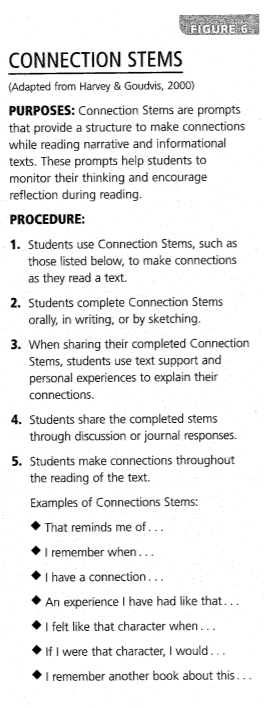
Students will likely have several connections to the picture book: perhaps they had a family member running in the Boston Marathon when the bombing occurred, maybe they or someone they know has a prosthetic leg(s), or possibly they or someone they know uses a service dog to do things. After students make their Connection Stems, they will share the connections they made through discussion or journal responses. This can lead into a critical thinking discussion about what it means to have a disability, visible and invisible struggles that come with having a disability, and what it means to be part of a supportive community. Check out the great Teacher’s Guide and Activity Guide to find more ideas about incorporating Rescue & Jessica into your classroom!
Like with Rescue & Jessica, Last Stop on Market Street would be a good book for students to work on their connection-making skills, as many students might relate to CJ and Nana’s journey. It could also lend itself to a discussion on poverty and hunger (Bishop, 2016), specifically looking first at what a soup kitchen is, who might work at or run a soup kitchen, or who might go to a soup kitchen; this might encourage students to do some social activism, perhaps wanting to volunteer somewhere on their own, or maybe inspire a class field trip to a soup kitchen to volunteer for a day. Last Stop on Market Street “can also be a starting point for examining one’s worldview and the way we respond to people whose circumstances are less fortunate than our own, as well as an incentive to try to make a difference by engaging in social action” (Bishop, 2016). Students might also be encouraged to think about the positive messages Nana tells CJ on their journey (i.e., “Sometimes when you are surrounded by dirt, CJ, you’re a better witness for what’s beautiful”) and what they mean for their own lives (Bishop, 2016).
Rescue & Jessica: A Life Changing Friendship, Red: A Crayon’s Story, and Last Stop on Market Street provide students with a critical lens that looks into dis/abilities, gender identity, social justice actions, and seeing the beauty in the everyday. I highly recommend all three of these #OwnVoices books for your classroom!
References

Bishop, R. S. (2016). A ride with Nana and CJ: Engagement, appreciation, and social action. Language Arts, 94(2), 120-123.
De la Peña, M. (2015). Last stop on market street. New York, NY: Penguin Random House Company.
Hall, M. (2015). Red: A crayon's story. New York, NY: Greenwillow Books.
Hall, M. (n.d.). Author's statement: Red: A crayon's story. Retrieved from https://www.michaelhallstudio.com/pages/books/crayon/authors-statement.html
Kensky, J., & Downes, P. (2018). Rescue and Jessica: A life-changing friendship. Somerville, MA: Candlewick Press.
McLaughlin, M., & DeVoogd, G. L. (2004). Chapter 2: Teaching critical literacy. In Critical literacy: Enhancing students' comprehension of text (pp. 34-58).
 Ms. Schmidt's Reading Blog