“‘I wish,’ she whispered, ‘for someone to love with all my heart.’
That was my first wish. And the beginning of many more.”
– Wishtree, Katherine Applegate
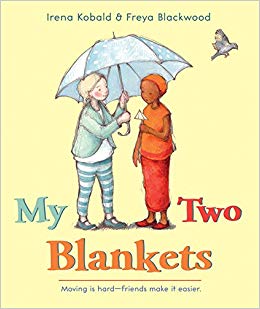
My Two Blankets, a 2014 picture book by Irena Kobald and Freya Blackwood, is about a young girl nicknamed Cartwheel by her auntie. Kobald draws on her experiences as a multilingual Austrian immigrant to Australia and her teaching of aboriginal children in Australian outback communities to write her first published picture book. She also found inspiration in a friendship that developed between her daughter and a Sudanese child. Cartwheel, a free and fun-loving spirit in her homeland, becomes sad and lonely when war comes to her country, forcing her and her auntie to move to a strange new country. Written in first-person, Cartwheel describes her loneliness as being “like standing under a waterfall of strange sounds. The waterfall was cold. It made me feel alone. I felt like I wasn’t me anymore” (p. 6).
To protect herself from her loneliness, Cartwheel wraps herself in a metaphorical blanket, made up of her “own words and sounds” (p. 8). That is, until a kind young girl waves to Cartwheel in the park. At first, when the girl spoke to Cartwheel, her words were like being back under the waterfall; but as the two girls became better friends and the girl taught Cartwheel new words from her language, and Cartwheel begins to weave a new blanket. Her new blanket, another metaphor for this new language, grew and grew, and eventually became “just as warm and soft and comfortable as my old blanket” (p. 27).
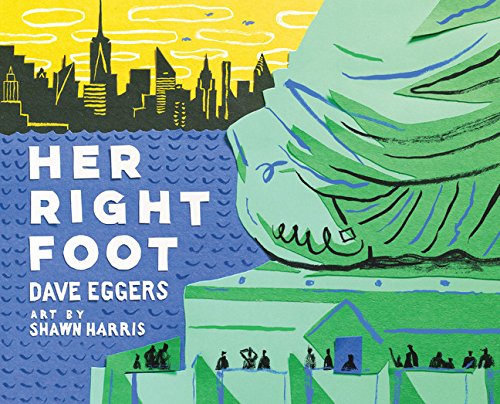
Her Right Foot, written in 2017 by Dave Eggers and illustrated by Shawn Harris, is a picture book about the right foot of the Statue of Liberty. The first half of the book delves into the history behind the building and transportation of Lady Liberty, the sculpture designed in France by Frédéric Auguste Bartholdi that now stands tall in New York City. Why her right foot, you ask? Because, the Statue of Liberty is “going somewhere! She is on the move!” (p. 51). That’s right, Lady Liberty is on a mission, with her right foot—her entire right leg—in mid-stride. But where is she going? Eggers says that she is “not content to wait” (p. 89) for the immigrants, “the poor, the tired, and yearning to be free” (p. 88), and “She must meet them in the sea” (p. 91).
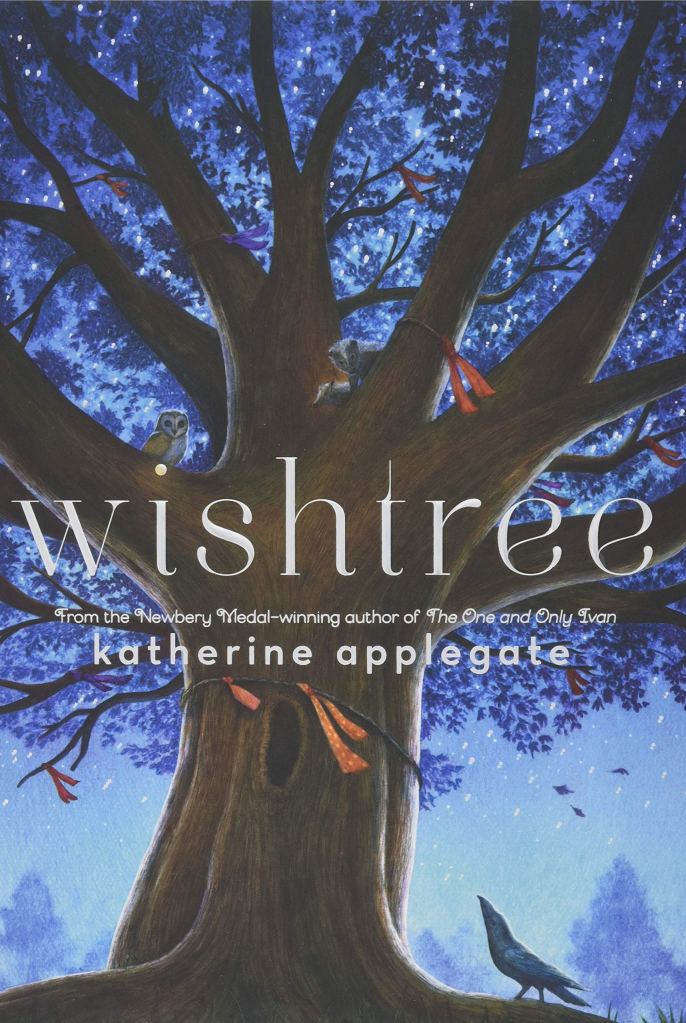
Wishtree, a 2017 novel by Newbery Medal-winning author Katherine Applegate, features a 216-year-old northern red oak tree named Red as the unexpected first-person narrator. Over the centuries Red has been alive, she has become what is known as a “wishtree,” an Irish tradition where people come on the first of May every year to tie scraps of paper, bits of fabric, and more, each representing a wish. Besides being a wishtree, Red is also a home to many animals in the neighborhood. Red, as the protector of the neighborhood, has seen everything.
That is, until a new family rents the tiny blue house that sits below Red’s shade. Red and the animals she shelters come to be very caring over the family’s little girl, Samar. After the nasty word “LEAVE” is carved into Red’s side, threatening Samar and her immigrant family, Red decides that she will protect Samar and grant her wish for a friend—even if that means breaking the rules a bit.
All three of these books details different immigrant experiences: in My Two Blankets, the narrator is the newcomer that must attempt to find her place in her new home; in Her Right Foot, it is the Statue of Liberty who moves toward immigrants and welcomes them to her country; in Wishtree, Red helps a Muslim immigrant make a new friend.
How can I apply lessons from these books to my own classroom?
Each of these books features a unique and positive perspective of the immigrant experience. We can use all three in a text set to give readers ready-made perspectives on the topic. Then in a discussion about immigration, we can juxtapose student thinking with those in the three books, as well as compare and contrast the thinking of each of the authors. Ask students what Dave Eggers wrote that helped them think differently about what Katherine Applegate wrote, or about what Applegate wrote that made them think differently about what Irena Kobald wrote.
It is important for students to note that although there are often similarities between the experiences of immigrants, not every migrant’s move will look the same. Emigrants move to new places all over the world (not just the United States) to escape war, famine, or danger, as we see in My Two Blankets. Migrants come from all over the world, too, which students can learn from reading Her Right Foot, particularly by looking at the spread below, which highlights just how different the immigrants that arrive in America can be:
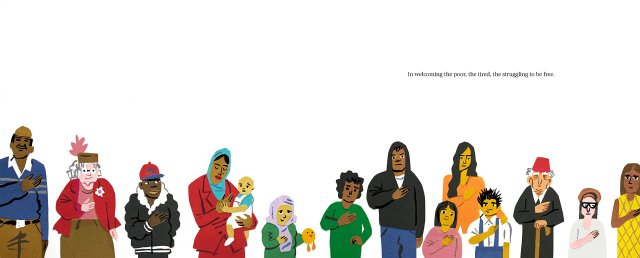
In the illustrative spread above, the emphasis is placed upon the people featured—the immigrants—that have come to the United States, while the text—though important—almost takes a backseat to the image. Each person has their right hand placed over their heart, symbolizing the significance and value each person sees in their migration to the U.S., regardless of what they look like, what age they are, and how they dress.
Shawn Harris, the illustrator of Her Right Foot, used construction paper and India ink to render the beautiful illustrations featured throughout the book. The gorgeous way that Harris uses his materials would never lead one to believe he simply used construction paper and India ink, as each page is a colorful and engaging representation of Eggers’ words, come to life. The way he uses color is also intriguing; for example, on the end pages and several other pages in the book, Harris will start on the left with brown, then end with blueish-green on the right (in the same way the Statue of Liberty’s copper skin transitioned from brown to green). The illustrations in Her Right Foot that Harris creates are, in my opinion, some of the most beautiful artworks in a children’s book I’ve seen.
If you are interested in looking more into how you can incorporate Her Right Foot and Wishtree into classroom discussions and lessons, check out the classroom guides and resources linked here and here.
So, are you looking for some awesome children’s books to critically discuss the immigrant experience with young students? Look no further than Wishtree, My Two Blankets, and Her Right Foot!
References

Applegate, K. (2017). Wishtree. NY: Feiwel and Friends.
Callow, J. (2017). “Nobody spoke like I did”: Picture books, critical literacy, and global contexts. The Reading Teacher, 71(2), 231-237. doi:10.1002/trtr.1626
Edwards, A. (n.d.). WOW stories: Connections from the classroom: Re-visioning the world through multiple perspectives. Retrieved from https://wowlit.org/on-line-publications/stories/storiesi2/15/
Eggers, D. (2017). Her right foot. San Francisco, CA: Chronicle Books.
Kobald, I. (2014). My two blankets. New York, NY: Houghton Mifflin Harcourt Publishing Company.
 Ms. Schmidt's Reading Blog